 ultimate-guide
Benefits of Using Mobile Towers for Industrial Maintenance
Table of Contents
- Why Mobile Towers Beat Fixed Access for Industrial Work
- The Core Benefits of Using Mobile Towers for Industrial Maintenance
- Meeting Work at Height Regulations 2005 Compliance on Site
- GRP Non-Conductive Scaffold Towers for Electrical Environments
- Understanding PASMA Training Requirements for Your Crew
- Choosing the Right Mobile Tower for the Task
- Conclusion
- Frequently Asked Questions
Last Updated: 8 September 2026
Fixed scaffolding and ladders have dominated industrial maintenance for decades, yet they introduce inefficiencies that cost facilities valuable downtime. The benefits of using mobile towers for industrial maintenance extend far beyond simple portability, offering a safer, more adaptable alternative that aligns with modern compliance standards. At Leader Pro Scaffold Towers, we supply BS EN1004-certified access equipment to trade and industrial professionals. Below, we break down exactly where mobile towers outperform fixed access and how to select the correct unit for your site.
Why Mobile Towers Beat Fixed Access for Industrial Work
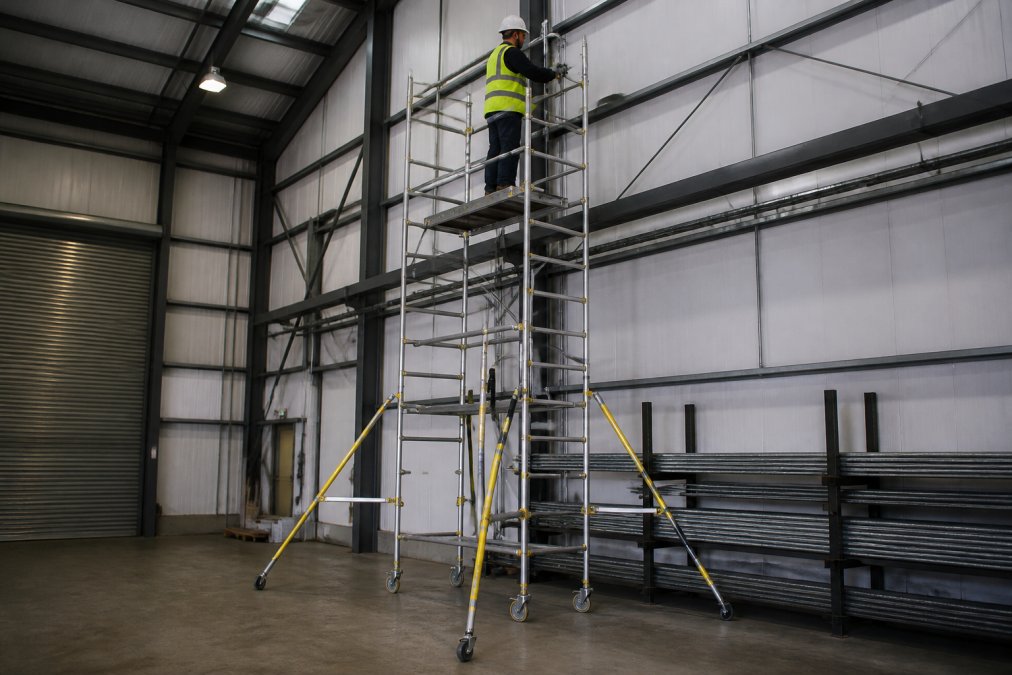
The primary advantage is mobility itself. A single mobile tower can be repositioned across a factory floor, warehouse aisle, or plant room in minutes, whereas fixed access requires assembly, dismantling, and re-erection at every new location. For maintenance teams covering multiple service points in one shift, this speed directly reduces downtime.
Consider a facility manager overseeing lighting replacements, conveyor belt repairs, and overhead duct cleaning. With a mobile tower, one unit serves all three tasks sequentially. Fixed scaffolding would demand either multiple structures or repeated rebuilds, multiplying labour costs. The tower also stores flat when not in use, freeing valuable floor space that permanent structures occupy.
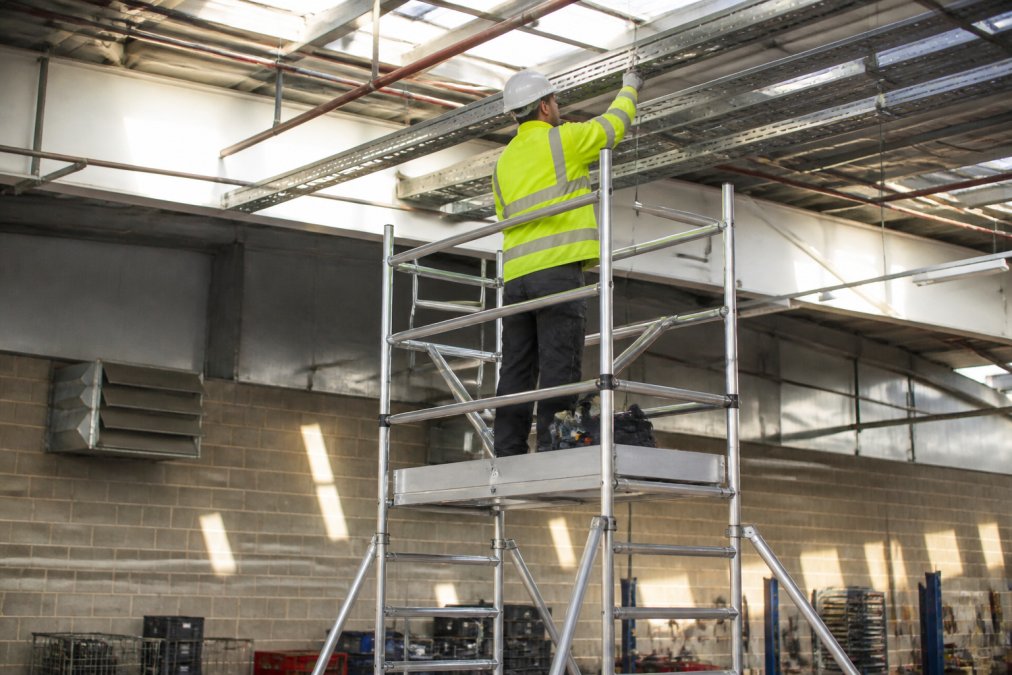
The real difference comes down to flexibility versus permanence. Fixed access suits long-term projects where workers return to the same height daily. Mobile towers excel in environments where tasks change frequently and access points shift, which describes most routine industrial maintenance.
The Core Benefits of Using Mobile Towers for Industrial Maintenance
The benefits of using mobile towers for industrial maintenance cluster around four practical outcomes: safety, efficiency, cost, and accessibility. Each one directly influences your bottom line and your crew's wellbeing.
- Stable working platforms: Modern towers provide guarded platforms with generous working space, reducing the risk of falls that exists with ladders.
- Rapid deployment: Most aluminium towers assemble in under 30 minutes with two workers, allowing tasks to start sooner.
- Cost-effective access: One mobile tower replaces multiple ladders and sections of fixed scaffold, lowering capital outlay.
- Reach and manoeuvrability: Towers on castors move through standard doorways and along corridors, reaching confined industrial spaces where plant machinery blocks permanent structures.
These advantages make mobile towers the default choice for planned preventive maintenance, emergency repairs, and inspection rounds. A common mistake is assuming a ladder suffices for short tasks; however, most industrial accidents occur during brief, low-height work where workers become complacent. The stable platform and guardrails of a mobile tower eliminate that risk entirely.
Meeting Work at Height Regulations 2005 Compliance on Site
Work at Height Regulations 2005 compliance is a legal obligation for every employer and contractor in the UK. The regulations require that work at height is properly planned, supervised, and carried out by competent persons, with equipment selected that is appropriate for the task. Mobile towers that meet the BS EN1004 standard provide a documented route to compliance because they are designed, tested, and certified to specific safety criteria.
The Health and Safety Executive guidance on work at height emphasises that duty holders must avoid work at height where possible and use equipment that prevents falls where it cannot be avoided. A BS EN1004 tower, erected on level ground with outriggers deployed, provides a collective protection measure that safeguards everyone on site, not just the individual worker.
For facilities managers, compliance documentation matters as much as the physical equipment. BS EN1004 certification provides auditable proof that your access equipment meets the required safety standard. When inspectors or clients request evidence, the certification tag on each tower component supplies the necessary traceability. Choosing uncertified or ageing equipment exposes your organisation to enforcement action and reputational damage.
GRP Non-Conductive Scaffold Towers for Electrical Environments
GRP non-conductive scaffold towers are essential where crews work near live electrical conductors, such as substations, overhead lines, and industrial switchgear. Unlike aluminium, glass-reinforced plastic does not conduct electricity, so a GRP tower provides a safe working platform without the risk of energising the structure through accidental contact.
The distinction matters because aluminium towers are excellent for general industrial work but hazardous near exposed live components. Electrical contractors should verify that every component of their GRP tower, including the platform and guardrails, is non-conductive. This mirrors the approach taken with insulated hand tools, where the entire system must protect the user.
For utility maintenance and electrical installation work, a GRP tower also offers resistance to chemical corrosion, making it suitable for harsh industrial atmospheres where aluminium would degrade. While GRP towers cost more than their aluminium counterparts, the safety case for live environments justifies the premium. Many electrical contractors keep both types on fleet, deploying aluminium for general tasks and GRP specifically for energised areas.
Understanding PASMA Training Requirements for Your Crew
PASMA training requirements exist because a mobile tower is only as safe as the person assembling and using it. The Prefabricated Access Suppliers and Manufacturers Association sets the recognised standard for tower erection and inspection training in the UK. Any worker who assembles, dismantles, or alters a mobile tower should hold a current PASMA certificate.
The training covers critical knowledge that informal instruction misses: correct stabiliser deployment, safe climbing techniques, platform loading limits, and how to identify damaged components. Accredited PASMA courses combine theory with practical assessment, ensuring operators can erect a tower correctly under supervision before working independently.
For employers, maintaining PASMA certification records demonstrates a commitment to competence that regulators and clients expect. The PASMA guidance on tower safety and training states that refresher training is recommended every five years, though many organisations require more frequent updates to reflect changing site conditions. When hiring contractors, facilities managers should request proof of PASMA certification before allowing tower work to begin on their premises.
Choosing the Right Mobile Tower for the Task
Selecting the correct tower requires matching the equipment to the working height, environment, and load demands of your specific task. Start by measuring the maximum working height you need, then account for the platform height plus the guardrail height to determine the required tower size. Most industrial applications need platforms between 2 and 8 metres, though larger configurations exist for specialised work.
The table below summarises the key selection criteria:
| Tower Type | Best For | Key Consideration |
|---|---|---|
| Aluminium tower | General trade and facility maintenance | Lightweight, corrosion-resistant, cost-effective |
| GRP tower | Electrical and utility environments | Non-conductive, chemical-resistant, higher cost |
| Small span tower | Confined spaces, narrow aisles | Fits through standard doorways |
| Wide span tower | Large platforms, heavy tools | Greater stability, higher load capacity |
Assess the ground conditions where the tower will operate. Uneven floors require adjustable legs or stabilisers, while soft ground may need spreader plates. For outdoor use, consider wind exposure; most towers have a maximum wind speed rating that operators must respect. Indoor industrial settings generally present fewer environmental challenges, but floor obstructions and overhead hazards still require a site survey before work begins.
The BS EN1004 standard for mobile access towers specifies load classes and safety requirements that guide selection. Towers certified to this standard display markings indicating their maximum load and configuration limits. Never exceed these ratings, as overloading is a leading cause of tower instability. When in doubt, consult the manufacturer's load tables or seek expert advice from your supplier.
Conclusion
Mobile towers deliver measurable advantages for industrial maintenance: they cut downtime through rapid repositioning, enhance safety with stable guarded platforms, and simplify compliance with the Work at Height Regulations 2005 when certified to BS EN1004. The key is matching the tower type, whether aluminium or GRP, to the specific demands of your environment and ensuring every operator holds current PASMA certification.
Choosing the right supplier matters as much as choosing the right tower. At Leader Pro Scaffold Towers, we offer manufacturer-direct pricing on BS EN1004-certified equipment, with next-day UK delivery and a comprehensive range of spare parts to keep your fleet operational. Our team provides expert advice on selecting the correct configuration for your industrial maintenance requirements. Get started with Leader Pro Scaffold Towers and equip your crew with access solutions built for safe, efficient work at height.
Frequently Asked Questions
Are aluminium mobile towers safe for electrical maintenance work?
No, standard aluminium towers conduct electricity. For work near live cables or electrical equipment, you need a GRP non-conductive scaffold tower. Glass-reinforced plastic platforms and frames provide electrical insulation, reducing the risk of shock. Always check the tower's specifications and your site's risk assessment before starting work.
What are the main regulations for using mobile access towers at work?
The Work at Height Regulations 2005 are the primary legislation governing all work at height, including mobile towers. They require employers to ensure work is properly planned, supervised, and carried out by competent people. Compliance also means using equipment that meets British standards like BS EN1004 and ensuring workers have received PASMA training for assembly and use.
How do mobile towers improve efficiency on industrial maintenance jobs?
A mobile tower lets one or two workers reach a work area quickly without waiting for a fixed scaffold erection or a powered access platform. Towers with stabilisers and adjustable legs set up fast on uneven factory floors. For multi-point maintenance, workers can move the tower along a bay, reducing downtime and keeping tools and materials within arm's reach.
Why is PASMA training required for my team?
PASMA training is the recognised standard for the safe assembly, use, and dismantling of mobile access towers. It ensures your crew can inspect equipment, identify hazards, and follow correct procedures, which is a core part of your duties under the Work at Height Regulations 2005. Many contractors and sites also require proof of a valid PASMA certificate before allowing work to begin.