 blog
blog
Best Scaffold Towers for Decorators: 2026 Guide
Table of Contents
- Why Decorators Need a Scaffold Tower, Not a Ladder
- What to Look for in Scaffold Towers for Decorators
- Scaffold Tower Safety Regulations UK: The Legal Minimum
- PASMA Training Requirements for Decorators Explained
- Aluminium vs GRP Towers for Interior and Exterior Work
- Cost of Industrial Scaffold Towers 2026: What to Budget
- Choosing the Right Tower for Your Decorating Business
- Conclusion: Invest in Safe Access for Faster Work
- Frequently Asked Questions
Last Updated: September 7, 2026
Ask any professional decorator what slows a job down, and most will point to access. Ladders force constant repositioning, leave one hand occupied with balance instead of the brush, and make cutting-in around coving or ceiling roses a slow, risky business. A scaffold tower solves that by giving you a stable, hands-free platform at working height. This guide from Leader Pro Scaffold Towers breaks down the best scaffold towers for decorators, covering safety law and material choice.
The core insight is simple: a tower is not a luxury purchase. Scaffold towers for decorators are a productivity tool. Below, we'll show you exactly how to specify the right one for your business, and where it is worth spending more.
Why Decorators Need a Scaffold Tower, Not a Ladder
A ladder is fine for changing a lightbulb. For a full day of cutting-in and rolling, it is the wrong tool. Every repositioning costs minutes, and working from a rung means your legs do the stabilising, not the platform. The result is slower work and a higher risk of a fall.
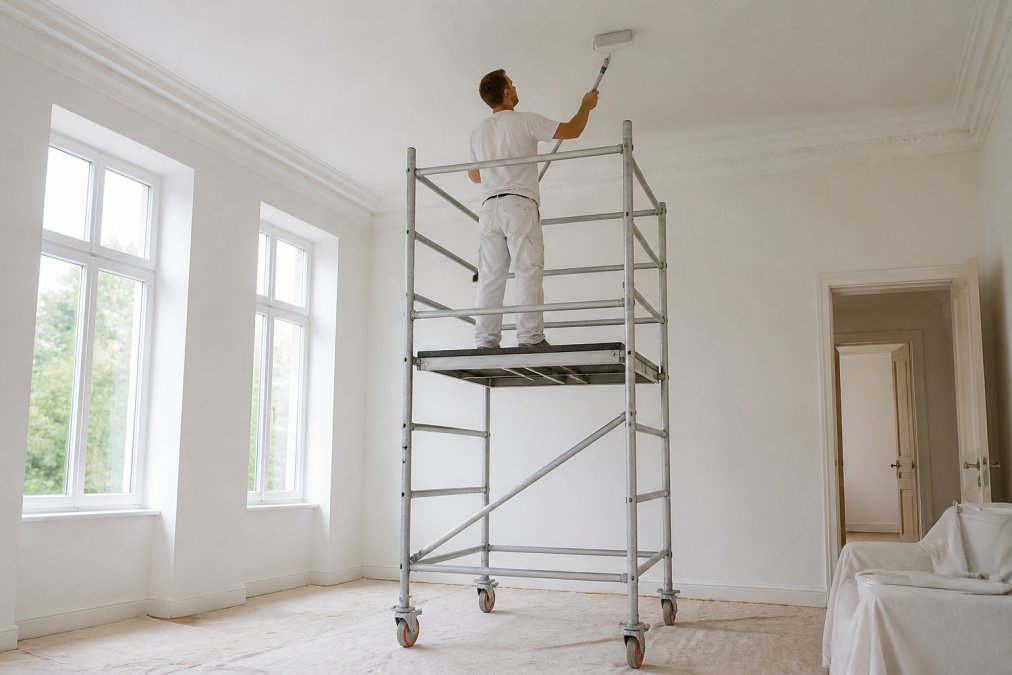
A tower changes the geometry of the job. You stand on a level platform with guardrails at waist height, both hands free, and your paint and tools sitting beside you. For stairwells, tall hallways, and commercial spaces with 4-metre ceilings, the time saving is substantial. Decorators who use towers can find they finish large rooms more efficiently because they are not constantly climbing down to move the ladder.
There is also a quality argument. When you can step back and view your work from a stable platform, cutting-in lines are cleaner and rolling is more even. Rushing because you are awkwardly balanced on a ladder is how mistakes happen.
What to Look for in Scaffold Towers for Decorators
Choosing the right tower comes down to working height, platform size, and portability. Most interior decorating jobs need a platform height of around 2.5 to 4.5 metres, which gives you safe reach to ceilings in standard and tall rooms without overspecifying.
Pay attention to the working platform dimensions. A platform that is too short forces you to climb down and move the tower mid-wall. Look for a platform long enough to cover a comfortable working span, typically 1.8 metres or more. For exterior work, wind exposure is a factor, so check the tower's wind rating and always use outriggers and stabilisers where the manufacturer specifies them.
Portability matters if you work alone. A tower made from aluminium sections is manageable by one person, but check the component weights. If you regularly work in loft conversions, a tower that breaks down into compact, lightweight sections that pass through tight openings will save you significant effort. For a deeper breakdown of the key differences between tower types and configurations, the Health and Safety Executive guidance on mobile tower scaffolds is a useful technical starting point.
Scaffold Tower Safety Regulations UK: The Legal Minimum
In the UK, the legal baseline is not a suggestion. The Work at Height Regulations 2005 place a duty on you, as an employer or a self-employed person, to ensure work at height is properly planned, supervised, and carried out from a safe place. Using a ladder where a tower is reasonably practicable is difficult to defend if something goes wrong.
The equipment itself must meet the harmonised standard. Towers manufactured to BS EN 1004 are designed to be safe when erected by trained operatives following the manufacturer's instructions. When you buy a tower, check for clear CE or UKCA marking and a declaration of conformity. This documentation is what an inspector or a principal contractor will ask to see on site.
Assembly errors are the most common cause of tower accidents. Components from different manufacturers are not interchangeable, and mixing parts can create a tower that looks right but is structurally unsound. Always buy a complete, matched system from a single supplier, and keep the instruction manual with the tower. The Work at Height Regulations 2005 text sets out the full legal framework you are working under.
PASMA Training Requirements for Decorators Explained
PASMA training is the industry standard for anyone who assembles, dismantles, or uses mobile access towers. While the law does not mandate a PASMA certificate by name, the Work at Height Regulations require that you are competent for the task. A PASMA course is the recognised way to prove that competence.
The course covers safe assembly, use, and dismantling of prefabricated towers, including how to read the manufacturer's instructions and how to inspect a tower for damage. It takes one day and includes a practical and theory assessment. For a self-employed decorator, holding a current PASMA card is increasingly expected by main contractors and clients before they let you on site.
If you employ staff, you are responsible for ensuring they are trained. A decorator who has never been shown how to fit a stabiliser correctly is a liability. Keep certificates current; PASMA cards are valid for five years, and refresher training is widely recommended. For details on course content and validity, check the PASMA official training standards.
Aluminium vs GRP Towers for Interior and Exterior Work
The material choice comes down to where you work. Aluminium towers are the default for most decorators because they are light, strong, and corrosion-resistant. For interior work and exterior painting where there is no electrical risk, aluminium is the best balance of cost and practicality.
GRP towers are the specialist option. Glass-reinforced plastic is non-conductive, which makes it the only sensible choice for work near live electrical services, such as commercial refits where you cannot guarantee isolation. The trade-off is weight and price. GRP sections are heavier than aluminium, which makes them more tiring to handle and more expensive to buy.
For a decorating business doing typical residential and light commercial work, aluminium is the right call. If you regularly take on jobs near overhead cables or in utility settings, a GRP tower for those specific contracts is a worthwhile investment. The table below summarises the practical difference.
| Material | Best Use | Key Advantage | Main Drawback |
|---|---|---|---|
| Aluminium | General interior and exterior decorating | Light and easy to assemble | Conductive near live electrics |
| GRP | Work near live electrical services | Non-conductive, safe near electrics | Heavier and more expensive |
Cost of Industrial Scaffold Towers 2026: What to Budget
The cost of industrial scaffold towers varies widely depending on working height, platform size, and material. Pricing depends on the specific configuration and features required.
Beyond the tower itself, factor in the accessories that make it site-ready. Stabilisers, outriggers, and guardrail panels are often sold as part of a full kit, but check carefully what is included in the price. A tower without the correct stabilisers for its height is not compliant, so a "cheap" tower that lacks them is a false economy.
A sensible approach is to price a complete, BS EN 1004-certified kit that meets your maximum working height, including delivery. For accurate, current pricing on industrial tower configurations, check the [Leader Pro(https://scaffold-tower.uk/product/leader-pro-trade-folding-towers) Scaffold Towers pricing page | scaffold-tower.uk] for manufacturer-direct rates and delivery options.
Choosing the Right Tower for Your Decorating Business
Start with your most common job type. If you do loft conversions and extensions, you need a tower that fits through tight openings and assembles quickly. If you do commercial redecoration with high ceilings, you need maximum platform height and a larger working platform to cover more wall per setup.
Consider how the tower will be transported. A van rack or trailer will dictate the maximum section length you can carry. Many decorators prefer a tower that breaks down into sections under 2 metres long for easy loading. Also think about how often you work alone; if you do, choose components light enough to handle single-handedly, and always follow the manufacturer's guidance on the number of people required for safe assembly.
Buying from a specialist supplier matters more than you might think. The best scaffold towers for decorators come with support: advice on configuration, a full range of spare parts if a section gets damaged, and delivery that does not hold up your job schedule. A tower built to BS EN 1004 with manufacturer-direct pricing and next-day UK delivery removes the risk of buying blind.
Conclusion: Invest in Safe Access for Faster Work
Working from a proper platform is safer, faster, and produces a better finish than balancing on a ladder. The right tower is a long-term asset that earns its keep on the first high-ceilinged room, and the legal and practical case for owning one is clear.
At Leader Pro Scaffold Towers, we supply BS EN 1004-certified aluminium and GRP towers direct from the manufacturer, backed by expert advice and a full range of spare parts. Get started with Leader Pro Scaffold Towers and find an access solution that keeps your team safe and your projects on schedule.
Frequently Asked Questions
What height scaffold tower do I need for painting a ceiling?
For standard 2.4m to 2.7m ceilings, a tower with a platform height of around 2.5m is usually sufficient, giving you comfortable headroom. Measure from the floor to the ceiling and subtract your height plus arm reach. You need the platform to sit roughly 1.2m to 1.5m below the ceiling so you can work without overreaching. Always check the tower's safe working height and ensure it is erected on level, firm ground.
Are scaffold towers better than ladders for decorators?
Yes, for most decorating tasks a scaffold tower is safer and more productive than a ladder. A tower gives you a larger, stable platform so you can move along the wall or ceiling without climbing up and down repeatedly. This reduces fatigue and the risk of falls, which is why the Work at Height Regulations UK require you to use the safest equipment for the job. For anything more than a quick touch-up, a tower is the professional choice.
Do I need a PASMA qualification to use a scaffold tower?
For self-employed decorators working on their own, formal PASMA training is not a legal requirement, but the law demands you are competent to erect and use the tower safely. On most commercial sites and for any work under CDM regulations, clients and principal contractors will insist on a valid PASMA certificate as proof of that competence. Even for domestic work, completing a PASMA course is the best way to learn correct erection procedures and safety checks.
What is the difference between a DIY and an industrial scaffold tower?
Industrial towers, such as those built to BS EN1004, are load-tested and certified for professional trade use, with stricter tolerances on materials and bracing. DIY towers are cheaper but often have lower safe working loads and may lack the stability needed for continuous daily use. For a decorating business, an industrial tower is a better investment because it is more durable, safer on uneven ground, and meets the standards required on commercial contracts.