 how-to
How to Check BS EN1004 Scaffold Certification
Table of Contents
- What BS EN1004 Certification Actually Covers
- Step 1: Find the Manufacturer's Data Plate and Label
- Step 2: Check the Certificate and Test Documentation
- Step 3: Run Through a Scaffold Tower Inspection Checklist
- How PASMA Scaffold Tower Regulations Fit In
- Your Duties Under the Work at Height Regulations 2005
- Common Mistakes When Checking Certification
- Conclusion
- Frequently Asked Questions
Last Updated: September 10, 2026
What BS EN1004 Certification Actually Covers
Knowing how to check BS EN1004 scaffold certification starts with understanding what the standard actually governs. BS EN1004 is the British and European product standard for mobile access towers, covering their design, strength, stability and safety requirements. A tower that meets it has been tested against defined load, wind and platform criteria.
The standard applies to the tower as a manufactured product. It does not certify the person erecting it, and it does not certify the completed structure on site. That distinction trips up a lot of buyers.
At Leader Pro Scaffold Towers, we supply aluminium and GRP towers built to BS EN1004, and the questions we field most often are about proof: what a certificate should show, where the data plate sits, and what to do when a site audit lands. This guide walks through each check in order.
Step 1: Find the Manufacturer's Data Plate and Label
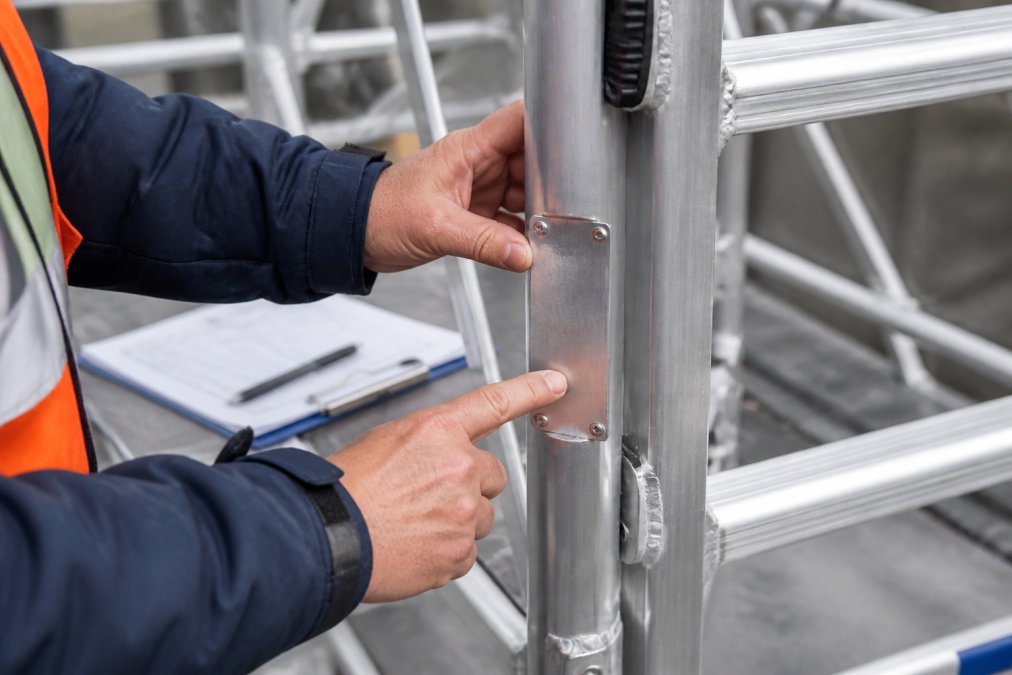
The data plate is your first and fastest check. Every compliant mobile access tower carries a permanent, legible label fixed to the structure, typically on a vertical frame or guardrail section. If you cannot find it, that is a red flag before you look at any paperwork.
A proper BS EN1004 data plate should show:
- The manufacturer's name or identifying mark
- The standard the tower is built to, stated as BS EN1004
- The tower class and maximum platform load
- Maximum platform height and safe working load
- Any restrictions on configuration or wind loading
Photograph the plate on receipt and store it with your site records. Auditors accept a clear image plus the original certificate; they do not accept a verbal assurance that it was there last week.
Step 2: Check the Certificate and Test Documentation
A certificate is only useful if it matches the tower in front of you. Start by confirming the manufacturer name on the certificate is identical to the name on the data plate. Mismatches usually mean the certificate belongs to a different model or a different production run.
Next, check the scope. The document should reference BS EN1004 and identify the specific tower model or range it covers. Look for a date of issue and, where applicable, an expiry or review date.
Then verify the issuer. Certificates issued by a recognised test house or notified body carry more weight than an in-house declaration, though both are common. If the issuer is unfamiliar, ask the supplier for the test report behind the certificate.
Step 3: Run Through a Scaffold Tower Inspection Checklist
A scaffold tower inspection checklist turns the paperwork check into a physical one. Use it every time a tower goes up, and again after any event that could affect stability. A common approach is to work top to bottom, then check the ground.
- Data plate present, legible and matching the certificate
- All frames, braces and guardrails free from cracks, bends or corrosion
- Platform boards undamaged, correctly located and fully decked
- Toe boards and guardrails fitted at the required height
- Adjustable legs or castors secure, with brakes applied where fitted
- Outriggers or stabilisers fitted where the height-to-base ratio requires them
- Ground firm, level and capable of carrying the loaded tower
- Tower vertical, with the built-in ladder or access method in place
Record the outcome, the date and who carried it out. Under the Work at Height Regulations 2005, inspection records form part of your evidence that the equipment was safe (hse.gov.uk).
| Check | What to Look For | Frequency |
|---|---|---|
| Data plate | Legible, matches certificate | On receipt and before each use |
| Structure | No cracks, bends or corrosion | Before each use |
| Platform | Boards intact and fully decked | Before each use |
| Stability | Legs, castors and outriggers secure | Before each use |
| Ground | Firm, level, load-bearing | Before each erection |
| Records | Signed and dated inspection log | Every inspection |
How PASMA Scaffold Tower Regulations Fit In
PASMA scaffold tower regulations are not law in themselves. PASMA is the industry body that sets training standards for mobile access tower users, and its guidance is widely treated as the benchmark for competence. The regulations that carry legal force come from the Work at Height Regulations 2005.
PASMA's role is to define what competent assembly and inspection look like, and to issue the cards that site managers recognise. A PASMA card proves the holder has been trained to assemble, move, inspect and dismantle towers safely.
The practical upshot: a BS EN1004 certificate proves the tower is sound, and a PASMA-trained operative proves the person is. Site audits usually ask for both. For more detail on training standards, see PASMA's official guidance on mobile access tower training.
Your Duties Under the Work at Height Regulations 2005
The Work at Height Regulations 2005 place specific duties on anyone who controls work at height. The Health and Safety Executive's guidance on the Work at Height Regulations sets out the core requirements in plain terms.
Your main obligations are:
- Avoid work at height where it is reasonably practicable to do so
- Prevent falls where work at height cannot be avoided
- Select equipment that is suitable, stable and strong enough for the task
- Ensure equipment is inspected at suitable intervals and after any incident
- Keep records of inspections and of the competence of those using the equipment
For mobile towers, this means checking certification, training and inspection records together. Missing any one of the three is where most enforcement action starts.
Common Mistakes When Checking Certification
The most frequent error is accepting a certificate at face value without matching it to the tower. Model names change, ranges get updated, and old certificates get reused. Always compare the certificate against the data plate on the actual structure.
A second mistake is conflating product certification with operator competence. A perfectly certified tower assembled by an untrained person is still a hazard. Keep the two checks separate and complete both.
Third, many teams skip the inspection record. If an incident occurs and there is no dated, signed log, you have no evidence the equipment was checked. A common approach is a simple paper or digital log kept with the tower.
Conclusion
Checking BS EN1004 scaffold certification comes down to three linked checks: verify the certificate and data plate, confirm the tower is sound with a structured inspection, and make sure the people erecting it are trained. Get any one of those wrong and the whole chain of compliance weakens.
Leader Pro Scaffold Towers supplies BS EN1004-certified aluminium and GRP towers direct from the manufacturer, with next-day delivery and a full range of spare parts to keep your equipment in service. Our team can talk you through the certification documentation for any tower in our range.
Frequently Asked Questions
What is the BS EN1004 standard for scaffold towers?
BS EN1004 is the British and European product standard covering mobile access towers made from aluminium or GRP. It sets requirements for strength, stability, platform dimensions, guardrails and toe boards. A tower marked BS EN1004 has been tested to these criteria, so it can be used as a compliant working platform when assembled and inspected properly.
How do I know if my scaffold tower is EN1004 certified?
Look for a permanent data plate or label on the tower frame showing the standard number, manufacturer name, model, safe working load and maximum platform height. Then check the certificate of conformity supplied with the tower matches those details. If the label is missing, damaged or doesn't match the paperwork, treat the tower as uncertified and do not use it until verified.
Is PASMA training required for EN1004 scaffold towers?
PASMA training is not a legal requirement in itself, but the Work at Height Regulations 2005 require anyone erecting, altering or dismantling a tower to be competent. PASMA courses are the recognised way to demonstrate that competence for mobile access towers. Most sites and principal contractors will expect a valid PASMA card before allowing tower work.
How often should scaffold towers be inspected for compliance?
A tower should be inspected before first use, after assembly, after any alteration or relocation, and following any event that could affect its stability, such as high winds or impact. On active sites, a formal inspection at least every seven days is standard practice. Record each inspection with date, tower ID and any defects found.
Compliant access at height depends on equipment you can trust and records you can produce on demand. Leader Pro Scaffold Towers offers manufacturer-direct pricing, BS EN1004-certified towers, fast next-day delivery and expert product advice to back it up. Get started with Leader Pro Scaffold Towers and equip your team with access solutions built to the standard.