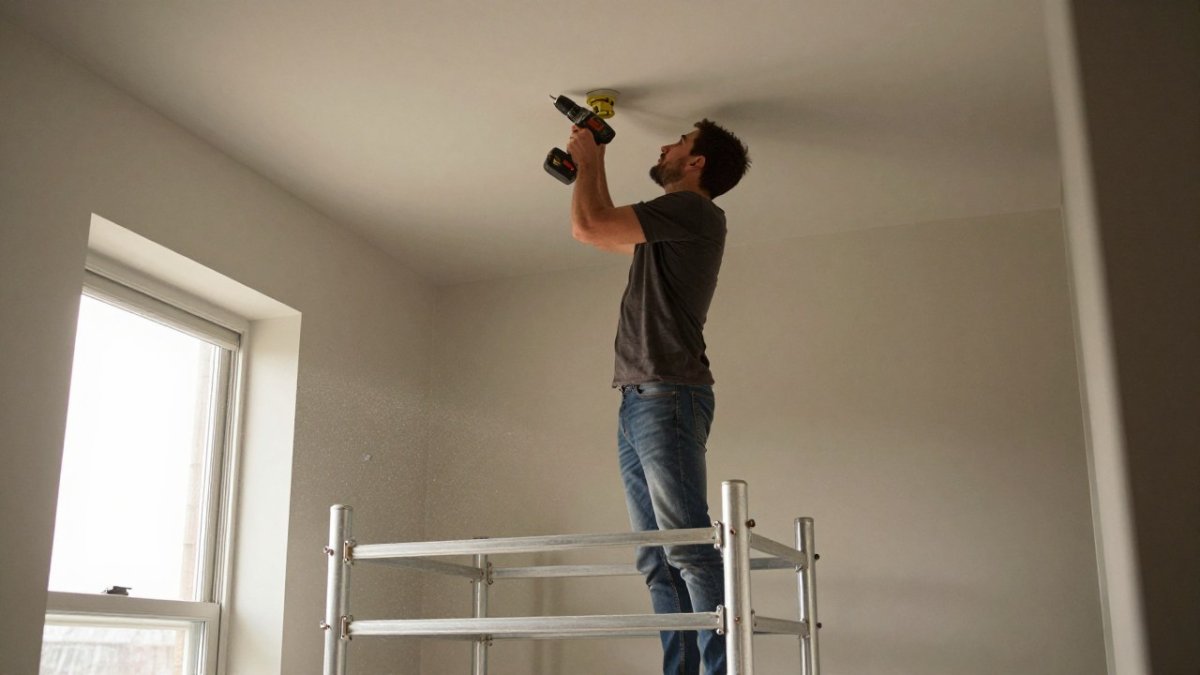
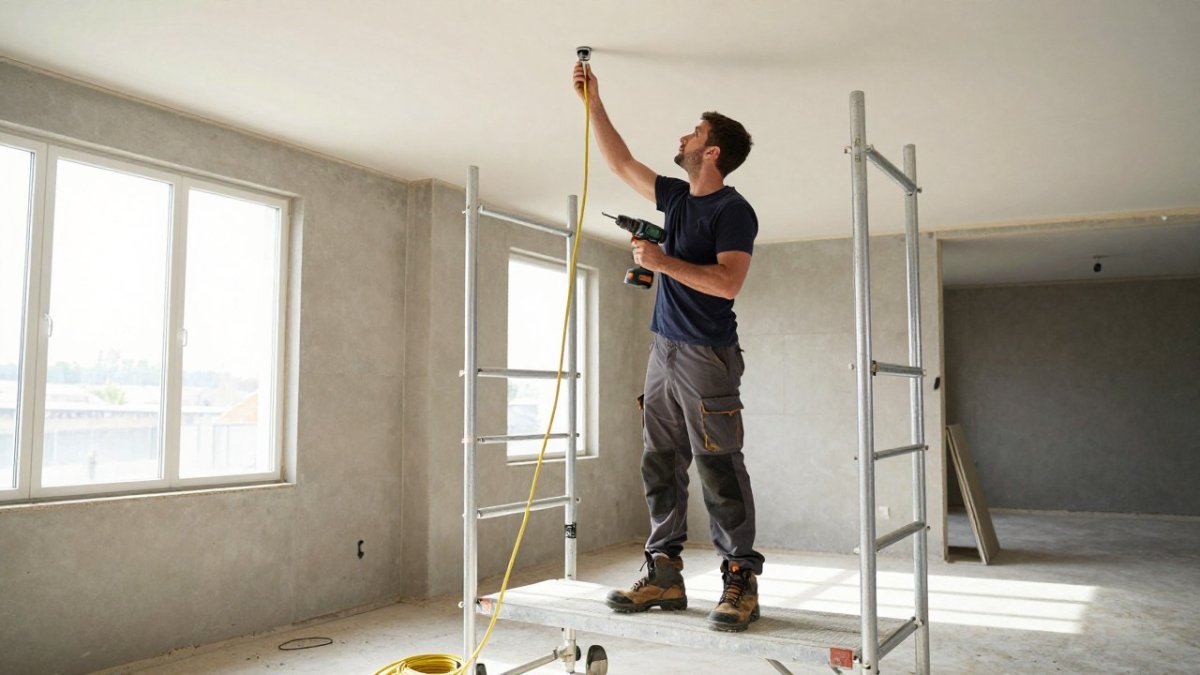
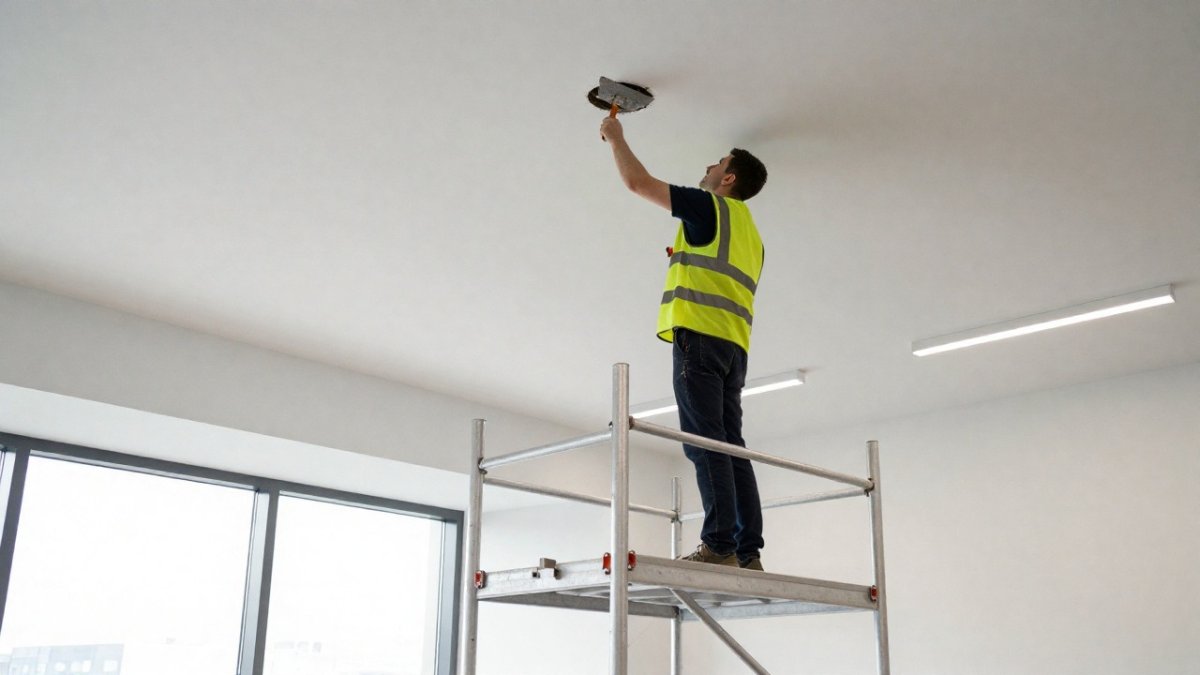
 Comparison
Ceiling Repair Access Solutions for Offices Compared
Last Updated: November 13, 2026
Quick Summary
For most office ceiling repair access, removable suspended tiles and dedicated access panels are the fastest route into the ceiling void, while localised plasterboard openings suit one-off repairs. Where sustained work at height is needed, a scaffold tower beats a podium step, and GRP towers are the sensible choice near electrical services.
- Lift individual suspended tiles by hand for routine maintenance, lighting swaps and valve access.
- Never stand on the ceiling grid or tile frame, as it is not designed to take a person's weight.
- Choose a scaffold tower over a podium step when the job needs a stable platform for more than a few minutes.
- Use GRP rather than aluminium towers wherever live or nearby electrical services present a risk.
- Replace damaged tiles with matching fire-rated and acoustic tiles, and seal access panels to maintain the fire line.
Table of Contents
- How Office Ceiling Repair Access Solutions Compare
- Access Panels and Removable Tiles for Office Ceiling Access
- Suspended Ceiling Maintenance Access Without Dismantling the Grid
- When a Scaffold Tower for Ceiling Repairs Beats a Podium Step
- GRP Scaffold Tower for Electrical Work Above Ceilings
- Repair or Replace: Deciding What the Damage Actually Needs
- Fire Performance, Acoustic Continuity and Compliance After Repairs
- Specifying the Right Tower for Your Next Ceiling Project
- Frequently Asked Questions
How Office Ceiling Repair Access Solutions Compare
Choosing the right ceiling repair access for offices comes down to matching the access method to the job, not to habit. A facilities manager with one stained tile needs a different setup from an electrician tracing a fault above a plasterboard ceiling.
Below, we break down where each solution works, where it falls short, and how to plan the work without dismantling more of the ceiling than you need to.
Access Panels and Removable Tiles for Office Ceiling Access
Access panels and removable tiles are the fastest route into a ceiling void, and for routine maintenance they are usually the right first choice. Office ceiling access panels are the permanent version of the same idea: products such as Armstrong's CASTWORKS GFRG access panels are designed for mechanical and electrical work above the ceiling, and come with lay-in or hinged doors.
But not all access solutions are equal. The table below compares the three main options for office ceiling repair access, removable suspended tiles, dedicated access panels, and localised plasterboard openings, across the criteria that matter most in an occupied office.
| Solution | Access frequency | Finish | Disruption | Best suited to |
|---|---|---|---|---|
| Removable suspended tiles | High, lift by hand, no tools | Standard grid appearance; tiles may become misaligned over time | Low, no cutting, no redecoration | Routine maintenance, lighting swaps, valve access, short inspections |
| Dedicated access panels | Medium to high, hinged or lay-in door | Clean, integrated finish; concealed options available | Low to medium, installation requires cutting the ceiling once | Repeated access in the same spot, services that need regular attention |
| Localised plasterboard openings | Low, cut and patch each time | Seamless once repaired and redecorated | High, cutting, patching, plastering and painting | One-off repairs above plasterboard ceilings, or where a permanent panel is not wanted |
Where panels and removable tiles work well:
- Lighting swaps and driver replacements
- Accessing valves, dampers and small HVAC components
- Short inspections of the ceiling void
- Any job where one person can reach the service from a step or low platform
Where Panels Work and Where They Fall Short
The limitation is reach and load, not convenience. A removable tile gives you a hole, not a working platform. If the repair needs sustained work with two hands above head height, or the ceiling void hides a fault you need to trace across several metres, lifting tiles will not get you there safely. A dedicated access panel improves repeat access but does not change the reach problem, you still need a safe platform to work from.
Watch out: standing on the ceiling grid or balancing on a tile frame is a common cause of falls and collapses. The grid is not designed to take a person's weight.
Suspended Ceiling Maintenance Access Without Dismantling the Grid
Suspended ceiling maintenance access should never mean pulling the grid apart. The grid carries the tiles and ties the whole system together; once it is disturbed, tiles drop out of level and the ceiling loses its line.
The correct approach is to remove only what you need. Lift the tiles around the work area, keep the grid intact, and set the removed tiles somewhere flat and protected.
If the work sits above a plasterboard ceiling rather than a suspended one, there are no removable tiles. You are into cutting an opening, which brings repair and redecoration into the job.
When a Scaffold Tower for Ceiling Repairs Beats a Podium Step
A scaffold tower for ceiling repairs wins whenever the job needs a stable platform at height for more than a few minutes. Podium steps suit quick, low-level tasks.
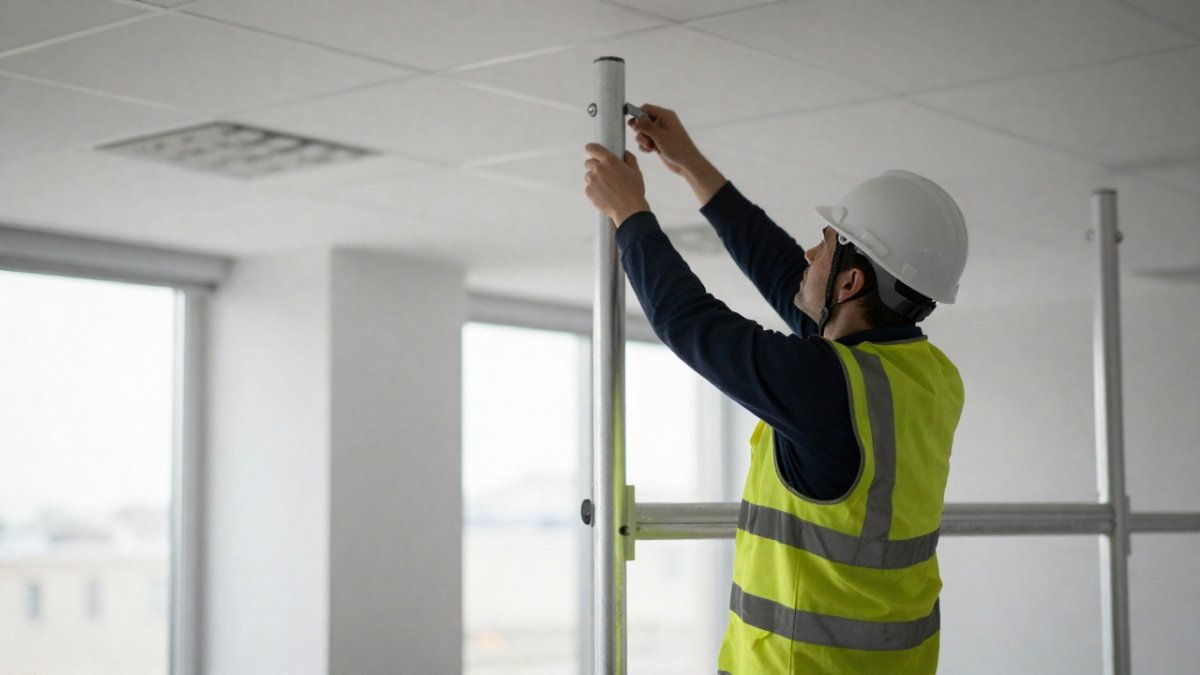
Stability, Load and Indoor Clearance Checks
Before erecting any tower indoors, check three things: floor condition, ceiling clearance, and the platform's load rating. Indoor floors are usually level, but check for raised access flooring, which can flex under a tower's feet.
- Confirm the working platform height clears the ceiling void you need to reach
- Check the tower's safe working load against your tools and materials
- Use stabilisers or outriggers as specified for the height
- Run a pre-use inspection before every erection
A practical scaffold tower inspection checklist takes the guesswork out of the pre-use check.
GRP Scaffold Tower for Electrical Work Above Ceilings
A GRP scaffold tower for electrical work is the non-conductive option, and for live or nearby electrical services it is the sensible choice over aluminium. Glass-reinforced plastic does not conduct electricity, so it removes a serious hazard when you are working close to cabling, distribution boards or unfamiliar wiring in a ceiling void.
Aluminium towers remain the workhorse for general maintenance, repairs and decoration. They are lighter, quicker to assemble, and cheaper for most jobs. The rule of thumb: aluminium for general ceiling work, GRP wherever electrical risk is present.
Repair or Replace: Deciding What the Damage Actually Needs
Most ceiling damage needs a repair, not a replacement, and the decision usually comes down to extent and cause. A single cracked tile, a water stain, or a sagging panel is a repair. Widespread sagging, repeated water damage, or a ceiling that has lost its grid alignment points to replacement. The table below maps common damage patterns to the likely fix and the access equipment you will need.
| Damage | Likely fix | Access needed |
|---|---|---|
| Cracked or stained tile | Swap the tile | Step or podium |
| Water damage across several tiles | Trace the leak, replace tiles | Tower for the trace |
| Sagging plasterboard | Cut out and patch | Tower |
| Grid out of level | Reset the grid | Tower |
| Repeated failures in one area | Investigate the cause above | Tower plus inspection |
Signs That Point to Replacement Rather Than Repair
A repair is usually the right call when the damage is localised and the cause is understood. Replacement becomes the better option when any of the following apply:
- The ceiling grid has lost its line across a wide area, which often happens after repeated tile removal or building movement.
- Water damage keeps returning to the same spot, suggesting an unresolved leak above.
- Tiles are sagging or dishing across multiple bays, which can indicate moisture ingress or overloaded services.
- The ceiling is a fire-rated or acoustic assembly and the damage has compromised its continuity.
Watch out: a water stain is a symptom, not the problem. Replacing stained tiles without tracing the leak above means the stain will return, and the underlying moisture can damage services or the building fabric.
Cost, Timescale and Disruption in an Occupied Office
Indicative costs vary with access method and extent, but the main cost drivers are labour time, access equipment hire, replacement materials and any redecoration. A single tile swap is a short job that one person can do from a podium step.
A common pattern in occupied offices is to schedule noisy or disruptive work, cutting plasterboard, erecting towers, drilling, outside normal working hours, and to keep routine tile swaps for quiet periods. Planning the access method early avoids the situation where a tower is erected in a busy area and then has to be moved because the floor cannot take the load or the ceiling clearance is wrong.
Fire Performance, Acoustic Continuity and Compliance After Repairs
Fire performance and acoustic continuity are the two things most often lost in a ceiling repair. A suspended ceiling is frequently a fire-resistance layer and an acoustic barrier, so replacing a tile with the wrong type, or leaving a gap around an access panel, can undo both.
- Replace tiles with matching fire-rated and acoustic tiles
- Seal access panels to maintain the fire line
- Keep acoustic insulation continuous across the repair
- Record what was changed for future maintenance planning
The Health and Safety Executive's guidance on work at height sets out the duties that apply to every ceiling job, and the Work at Height Regulations require that access equipment is suitable, stable and inspected. Getting the platform right is part of compliance, not an afterthought.
Specifying the Right Tower for Your Next Ceiling Project
Specifying the right tower starts with three numbers: the height you need to reach, the load you will put on the platform, and the floor space you have to work in. Match the tower to those, and the rest of the decision follows.
For most office ceiling work, an industrial aluminium tower covers the job. Choose GRP where electrical risk exists. Confirm the tower meets BS EN1004 before you buy.
If you are unsure who should assemble the tower, our guide to what PASMA is explains the training and competence requirements. When you are ready to choose, browse our industrial scaffold towers to match a tower to your ceiling project.
Ceiling repairs in occupied offices reward planning: the right access method saves time, protects the ceiling, and keeps everyone safe.
Frequently Asked Questions
What is the safest way to access a ceiling for repairs in an office?
Match the access method to the height and duration of the task. For short jobs at low level, a stable podium step works. For anything above roughly two metres, or work lasting more than a few minutes, a BS EN1004-certified scaffold tower gives a stable working platform. Never stand on desks, chairs or the ceiling grid itself. Before starting, check the floor is level, the area below is cordoned off, and the tower is assembled to the manufacturer's instructions by someone competent.
When should you use a scaffold tower for ceiling repairs?
Use a scaffold tower for ceiling repairs when the work involves reaching above standard step height, when more than one person needs to work at height, or when tools and materials must be carried up. Towers suit replacing damaged tiles, repairing grid sections, installing or moving access panels, and servicing light fittings or diffusers. They also help where the ceiling void needs sustained access over a shift rather than a quick inspection.
Are aluminium scaffold towers suitable for electrical work?
Aluminium conducts electricity, so it is not the right choice where live conductors or exposed electrical components are present. For that work, specify a GRP scaffold tower for electrical work. Glass-reinforced plastic is non-conductive and is the standard choice for electrical contractors working near distribution boards, cable trays or lighting circuits. Confirm the tower is certified to BS EN1004 and check the duty rating suits the tools and people using it.
Do office ceiling repairs require an access panel?
Not always, but panels make future work far easier. Removable tiles give quick entry to the ceiling void, yet repeated removal can loosen the grid and damage tile edges. Where services sit above a plasterboard or fixed ceiling, an office ceiling access panel is the practical answer. Choose a panel sized for the largest item that may need servicing, and check it maintains the ceiling's fire and acoustic performance.
What should facilities managers check before using a tower indoors?
Confirm the floor can take the tower's point loads, especially on raised access floors, and check for level ground. Measure the ceiling height against the tower's platform height so you have working clearance above. Verify the tower is BS EN1004 certified, that stabilisers or outriggers are fitted as specified, and that anyone assembling it is PASMA trained. Keep the area below clear and check for overhead services before erecting.