 Listicle
10 durable access equipment for commercial buildings
Last Updated: November 15, 2026
Quick Summary
Durable access equipment is any platform, tower or lift built to survive repeated use on a commercial site while keeping the operator safe at height. Choose on total cost of ownership, not purchase price: inspection time, spare parts availability and how long the kit stays compliant matter more than a cheap sticker. Leader Pro aluminium towers, scissor lifts, boom lifts and GRP towers are among the ten options covered.
- The Work at Height Regulations 2005 require equipment that is suitable, stable and maintained.
- Leader Pro towers are built to BS EN1004 and sold direct from the manufacturer.
- Scissor lifts suit flat floors and straight-up reach but are less forgiving on uneven ground.
- Boom lifts need thorough examination at intervals under PUWER, so budget for examiner time.
- GRP towers do not conduct, making them the answer for electrical work, but they cost more than aluminium.
Table of Contents
- What Durable Access Equipment Actually Means for a Commercial Building
- Quick Comparison: Ten Access Equipment Options at a Glance
- 1. Leader Pro Aluminium Scaffold Towers: The Durable Workhorse for Routine Maintenance
- 2. Scissor Lifts for Indoor and Outdoor Access in Commercial Buildings
- 3. Boom Lifts: Articulating and Telescopic Models for High Reach
- 6. GRP Scaffold Towers for Electrical Work and Non-Conductive Access
- Frequently Asked Questions
What Durable Access Equipment Actually Means for a Commercial Building
Durable access equipment is any platform, tower or lift built to survive repeated use on a commercial site while keeping the operator safe at height.
The better measure is total cost of ownership: purchase price, inspection time, spare parts availability and how long the platform stays compliant.
Before you compare models, get the safety framework straight. The Health and Safety Executive guidance on tower scaffolds also expects towers to be assembled by trained people and inspected before first use.
Two practical assets worth bookmarking: our guide to how high a scaffold tower safely goes and the list of common assembly mistakes that quietly undermine an otherwise sound tower. Both matter more than the spec sheet when you are choosing durable kit.
Quick Comparison: Ten Access Equipment Options at a Glance
The table below summarises all ten options in this guide by task, environment and durability profile. Use it to shortlist two or three, then read the detail. The 'Reusable' column reflects whether the kit is built for repeat deployment on a building you manage, rather than a single project.
| Option | Best For | Environment | Reusable | Typical Durability Consideration |
|---|---|---|---|---|
| Leader Pro aluminium towers | Routine maintenance | Indoor and outdoor | Yes | Corrosion-resistant frame; spare parts held as a standing range |
| Scissor lifts | Flat indoor floors | Indoor, some outdoor | Yes | Battery and hydraulic service intervals drive lifecycle cost |
| Boom lifts | High reach | Outdoor | Yes | Structural inspection regime and tyre wear on rough ground |
| Cherry pickers and MEWPs | Vehicle-mounted reach | Outdoor | Yes | Chassis and boom wear; hire often better for one-off jobs |
| Podium steps and low-level kit | Quick short jobs | Indoor | Yes | Platform and guardrail condition; cheap to replace but easy to abuse |
| GRP towers | Electrical work | Indoor and outdoor | Yes | Non-conductive but needs the same inspection discipline as metal |
| Stair podium | Staircases and uneven surfaces | Indoor | Yes | Adjustable leg mechanisms are the wear point |
| Vertical mast lifts | Tight indoor aisles | Indoor | Yes | Mast and winch service life; narrow footprint suits retail |
| Towable boom lifts | Mobile external work | Outdoor | Yes | Road tow running gear and stabiliser wear |
| Modular access platforms | Plant rooms and ceiling voids | Indoor | Yes | Component interchangeability determines repairability |
Before you use the table, apply the building-specific criteria that decide whether a durable option is actually suitable for your site:
- Ceiling height and working height: measure the finished floor to the highest point you need to reach, then add the operator's reach. A tower rated to a given height still needs clearance to assemble safely.
- Floor loading: plant rooms, mezzanines and older suspended floors may not take the point load of a loaded scissor lift. Check the manufacturer's ground-bearing pressure against the building's structural limits.
- Aisle width and door dimensions: a scissor lift that fits the warehouse aisle may not pass the fire door into the atrium. Measure the narrowest point on the route, not just the work area.
- Lift dimensions: if the kit has to travel between floors, the lift car's internal height and door width become a hard constraint.
- Indoor emissions: battery-electric and manual kit suit enclosed spaces; diesel plant needs ventilation and is usually an outdoor choice.
- Storage: durable equipment still degrades if stored damp or dismantled badly. Confirm you have a dry, secure bay before you buy.
- Frequency of use: daily repeat tasks justify ownership and a spares holding; occasional one-off jobs are usually better hired.
A common pattern is that facilities teams shortlist on working height alone, then discover the machine will not fit the lift or the aisle. Working through the criteria above before the table saves a costly return.
1. Leader Pro Aluminium Scaffold Towers: The Durable Workhorse for Routine Maintenance
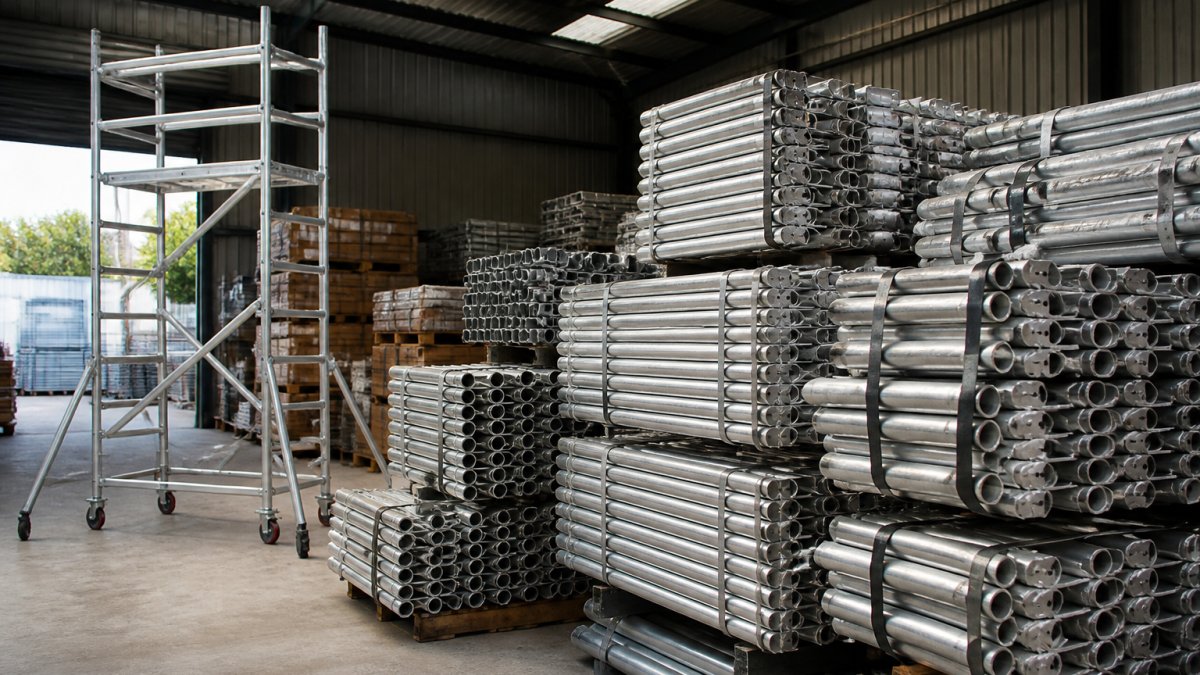
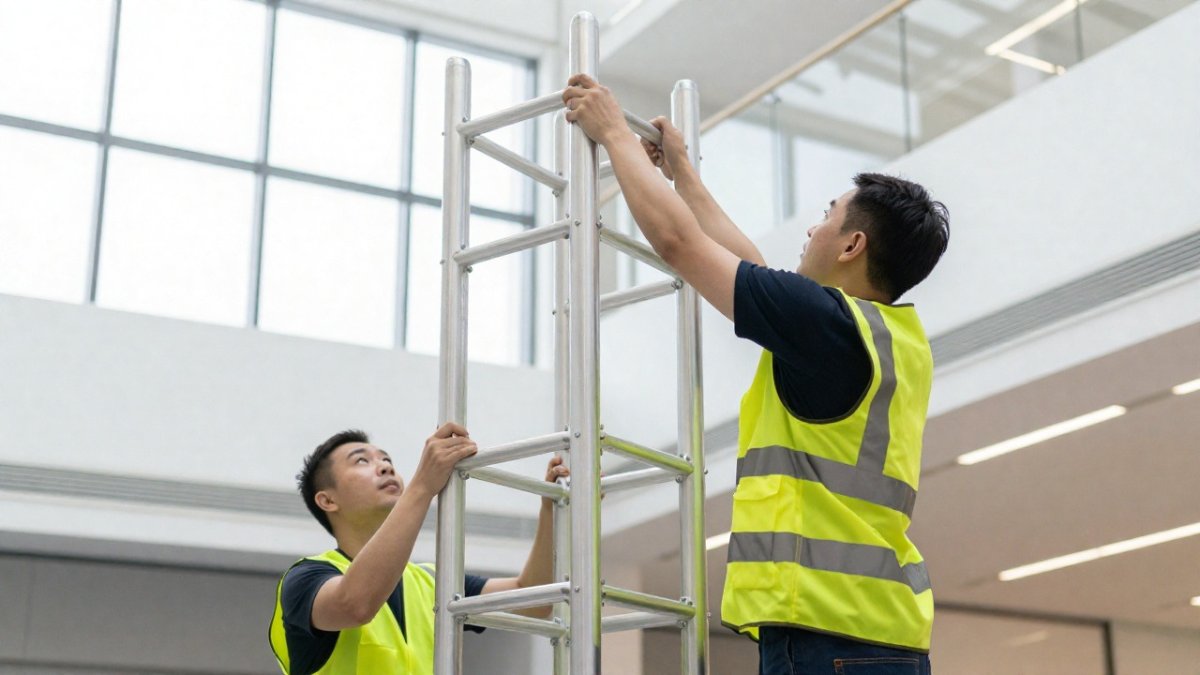
An aluminium scaffold tower is a practical choice for many commercial buildings. Leader Pro towers are built to BS EN1004 and sold direct from the manufacturer.
The aluminium frame is built to resist corrosion, and our next-day UK delivery is designed to limit downtime if a section is damaged. That last point is what most buyers miss. Downtime, not purchase price, is where access equipment budgets quietly leak.
Best for: facilities teams and contractors doing repeat maintenance. Skip if: you need powered reach above the tower's safe height limit.
Browse the full industrial scaffold tower range to see the heights and configurations available.
2. Scissor Lifts for Indoor and Outdoor Access in Commercial Buildings
Scissor lifts suit flat floors and straight-up reach. They are the standard choice for indoor work such as ceiling services, lighting and duct cleaning, where a stable platform and a decent working area matter more than height.
They are less forgiving on uneven ground. If your building has sloped loading bays or soft surfaces, check the manufacturer's ground-condition limits before you commit.
- Strengths: stable platform, good capacity, easy indoor manoeuvring
- Limits: vertical reach only, ground-dependent
- Typical use: warehouse access, atrium maintenance, plant rooms
3. Boom Lifts: Articulating and Telescopic Models for High Reach
Boom lifts reach where towers and scissor lifts cannot. Articulating models bend around obstructions, which makes them useful for cladding, signage and roof-line work.
Where boom lifts earn their keep on a commercial building:
- Roof-line and façade inspections: articulating booms can place an operator close to a parapet or gutter line without the setup time of a scaffold.
- High-level signage and lighting: telescopic reach suits tall, clear elevations where there is nothing to obstruct the platform.
- Cladding and glazing remediation: the ability to reposition along a façade without dismantling and rebuilding access is the productivity gain.
- Atrium and high-ceiling internal work: only where the machine can be driven in and the floor can take the load, many atria are not designed for wheeled plant.
Durability and lifecycle considerations specific to booms:
- Structural inspection regime: booms are subject to thorough examination at intervals under the Provision and Use of Work Equipment Regulations 1998 (PUWER), and the examination regime is more involved than for a tower. Budget for examiner time, not just purchase price.
- Hydraulic and battery service life: the hydraulic system and battery pack are the main wear items. A machine with a documented service history and available spares will outlast a cheaper unit with an obscure parts chain.
- Tyre and running-gear wear: outdoor use on rough ground accelerates tyre and brake wear. If your site has gravel or uneven hardstanding, factor replacement into the lifecycle cost.
- Repairability: check that the manufacturer or hire supplier holds common spares in the UK. A boom sidelined for a fortnight awaiting an imported part costs more in downtime than the part itself.
Boom lift versus tower, the honest trade-off:
A boom lift is faster to deploy for high, intermittent tasks and avoids assembly time.
Operator training and supervision:
Boom lifts are mobile elevating work platforms (MEWPs), and operators need training for the specific machine type.
Watch out: a boom lift's reach can tempt operators to work over pedestrians or traffic.
(https://scaffold-tower.uk/product/leader-pro-industrial-podium-steps) and the [stair podium](https://scaffold-tower.uk/product/leader-pro-stair-podiums) both cover this ground.- Podium steps: quick jobs on level floors
- Stair podium: staircases and uneven surfaces
- Ladders: last resort, short duration only
6. GRP Scaffold Towers for Electrical Work and Non-Conductive Access
GRP towers are the answer for electrical work. Glass-reinforced plastic does not conduct, so it suits utility and industrial environments where aluminium is a risk.
They cost more than aluminium and need the same inspection discipline. Under PUWER, work equipment must be inspected at suitable intervals, and that applies to GRP just as it does to metal. Our GRP towers are built to the BS EN1004 standard.
Best for: electrical contractors and utility work. Skip if: you only need general maintenance access.
Choosing durable access equipment comes down to matching the platform to the task, then checking the lifecycle cost rather than the sticker price.
Frequently Asked Questions
What are the Work at Height Regulations 2005 requirements for commercial buildings?
The Work at Height Regulations 2005 require duty holders to avoid work at height where possible, prevent falls where work at height cannot be avoided, and reduce the distance and consequences of a fall. For commercial buildings this means planning every task, selecting suitable access equipment such as a scaffold tower or MEWP, ensuring the platform is stable and complete, and confirming anyone working at height is competent. You must also record risk assessments and keep equipment inspected. Leader Pro towers are built to BS EN1004, which supports compliance.
Which type of access equipment is best for electrical maintenance?
For electrical maintenance, non-conductive GRP scaffold towers for electrical work are the safer choice because glass-reinforced plastic does not conduct electricity the way aluminium does. A GRP tower keeps the platform isolated if a cable is accidentally contacted. For higher or more mobile tasks, a MEWP with the correct insulation rating may suit, but the tower remains the practical option for fixed indoor and outdoor maintenance points. Always confirm the tower's certification and inspect it before use.
How do I choose between aluminium towers and GRP platforms?
Choose aluminium when weight, cost and speed of assembly matter most, such as routine building maintenance, painting or cleaning. Choose GRP when the work involves or sits near live electrical circuits, because the non-conductive material adds a layer of protection. Aluminium towers are lighter and usually cheaper; GRP towers cost more but suit utility and industrial environments. Both should meet BS EN1004. Match the material to the task, not to habit.
How often should commercial access equipment be inspected under PUWER?
PUWER inspection requirements mean work equipment that is exposed to conditions causing deterioration must be inspected at suitable intervals, and the results recorded. For access equipment such as scaffold towers and MEWPs, many sites inspect before each use and carry out a formal recorded inspection at intervals set by risk assessment, often weekly or monthly. A competent person should complete the checks, and any damaged component should be replaced before the tower is used again. Keep the records on site for audits.