 How-to
7 Access Equipment Choices for High-Rise Window Cleaning
Last Updated: 27 October 2026
Quick Summary
Choosing the right access equipment for high-rise window cleaning starts with the building: its height, the ground conditions and the glass position decide your options. Ladders, scaffold towers, MEWPs and rope access each trade setup time against reach, cost and ground space, so match the method to the building before comparing prices.
- Answer three questions first: maximum pane height, legal ground space and what sits underneath.
- Scaffold towers suit low to mid-rise buildings with firm ground and a small footprint.
- MEWPs need hard, level ground plus trained operators and ground bearing checks.
- Rope access needs almost no ground space but demands certified technicians and rescue provisions.
- Complete a working at height risk assessment before selecting any equipment.
Table of Contents
- Start With the Building, Not the Equipment
- Window Cleaning Access Methods Compared
- Scaffold Towers for Window Cleaning: Where They Work Best
- When a MEWP for Window Cleaning Is the Right Call
- Rope Access and Suspended Platforms: High-Rise Reach Without Ground Space
- Working at Height Risk Assessment Before You Choose
- Match the Access Equipment to Your Building and Book Your Tower
- Frequently Asked Questions
Start With the Building, Not the Equipment
Choosing the right access equipment for high-rise window cleaning starts with the building, not the catalogue. The height, the ground conditions and the glass position decide your options long before price enters the conversation.
A four-storey office with a flat forecourt is a different job from a glass-fronted block with a narrow pavement and a basement lightwell. One suits a tower. The other may need rope access or a MEWP.
So before you compare anything, answer three questions:
- How high is the highest pane you need to reach?
- What ground space can you legally occupy?
- What sits underneath, and can it take weight?
Get those wrong and no amount of equipment fixes it. Our guide to how to choose the right scaffold tower walks through working heights, widths and materials if a tower looks likely.
Window Cleaning Access Methods Compared
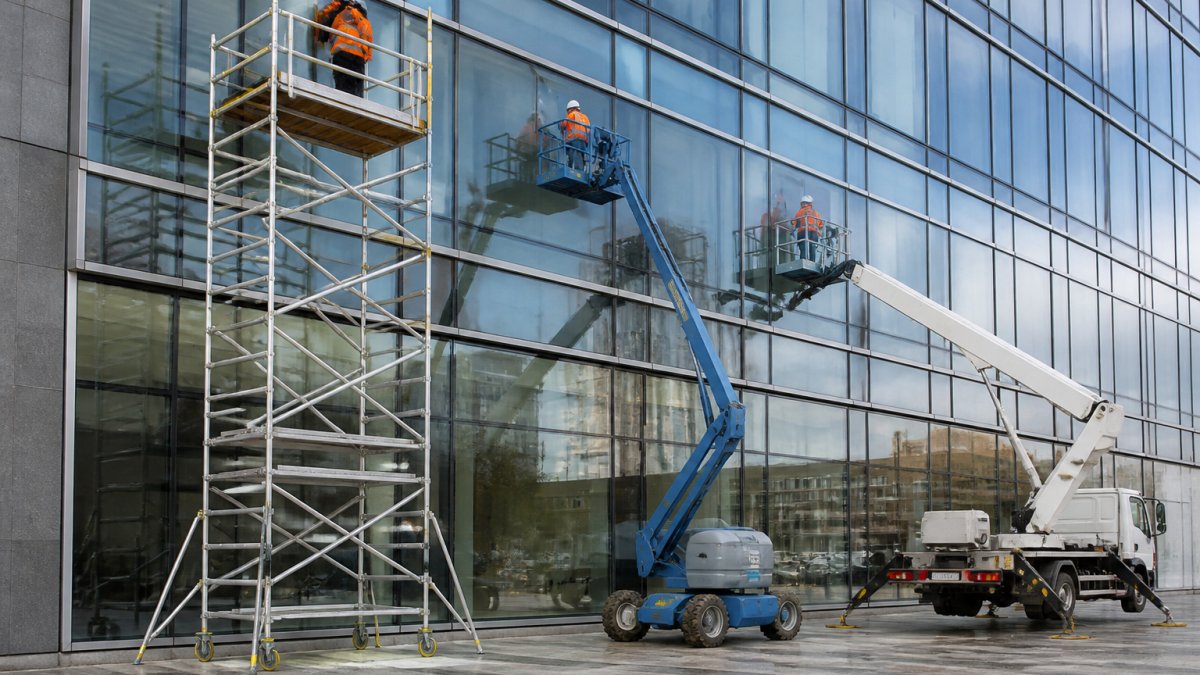
Window cleaning access methods fall into four main groups: ladders, scaffold towers, mobile elevating work platforms (MEWPs) and rope access. Each trades setup time against reach, cost and ground space.
Ladders are quick for low work but limited and risky for anything sustained at height. Towers give a stable platform for short to medium buildings. MEWPs reach higher and move fast but need hard, level ground. Rope access handles tall buildings with almost no footprint.
| Method | Typical Reach | Ground Space Needed | Best For |
|---|---|---|---|
| Ladders | Low level only | Minimal | Quick ground-floor panes |
| Scaffold towers | Low to mid-rise | Small footprint plus stabilisers | Recurring facade cleaning |
| MEWPs | Mid to high-rise | Hardstanding and turning room | Large glazed elevations |
| Rope access | High-rise | Almost none | Tall buildings, tight sites |
The trade-off is always the same: more reach means more setup, more cost or more ground space.
Scaffold Towers for Window Cleaning: Where They Work Best
Scaffold towers for window cleaning win on low to mid-rise buildings where the ground is firm and you can spare a small footprint. They give a stable, guarded platform, and a single-width tower fits where a MEWP never could. The Health and Safety Executive guidance on working at height is clear that a suitable platform beats improvised access wherever it can be used.
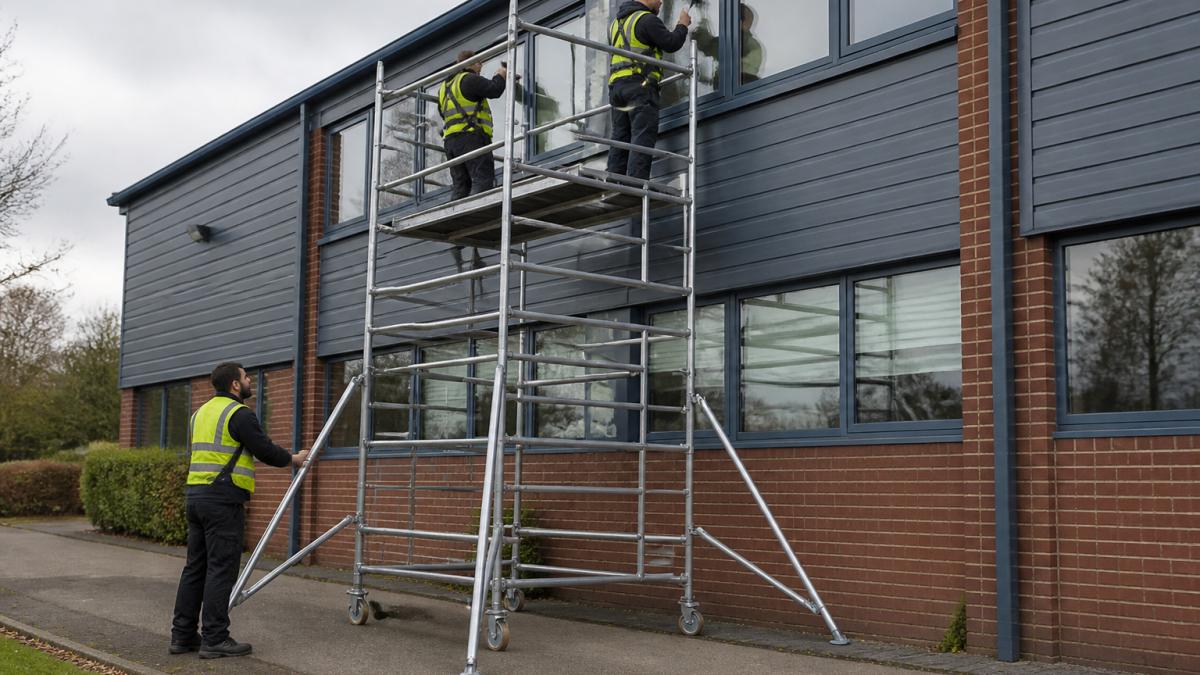
The catch is height. Towers are built to a standard, and you must stay within it. Our breakdown of how high a scaffold tower can safely go covers the limits, stabilisers and wind conditions that decide whether a tower suits your building.
When a MEWP for Window Cleaning Is the Right Call
A MEWP for window cleaning makes sense when the building is too tall for a tower and the site has hard, level ground for the machine. For high-rise work where a tower still suits, see the Leader Pro GRP industrial scaffold tower. Scissor lifts suit flat facades; boom lifts reach over obstacles and around corners.
They are fast to reposition and need no assembly. The trade-offs are real, though:
- Higher hire cost than a tower
- Need for trained, competent operators (Mobile elevating work platforms (MEWPs))
- Ground bearing and overhead clearance checks
- Traffic management on busy frontages
Rope Access and Suspended Platforms: High-Rise Reach Without Ground Space
Rope access and suspended platforms reach tall buildings where there is no room for anything else. Operatives work from harnesses on ropes, or from a cradle lowered on cables. Neither needs a ground footprint beyond a small exclusion zone.
This is specialist work. It demands certified technicians, thorough planning and strict rescue provisions. For a one-off clean on a glass tower, it may be the only practical option. For routine cleaning, the cost of a specialist team adds up.
The real difference between rope access and a tower comes down to frequency. Regular cleaning of a mid-rise block usually favours a tower you can erect and reuse. Occasional work on a tall facade points to rope access.
Working at Height Risk Assessment Before You Choose
A working at height risk assessment must come before you pick any equipment, not after. It sets out the height, the hazards and the control measures, and it tells you which method is actually safe.
Work through these steps:
- List every task and the maximum height involved
- Identify hazards: wind, ground condition, overhead lines, public access
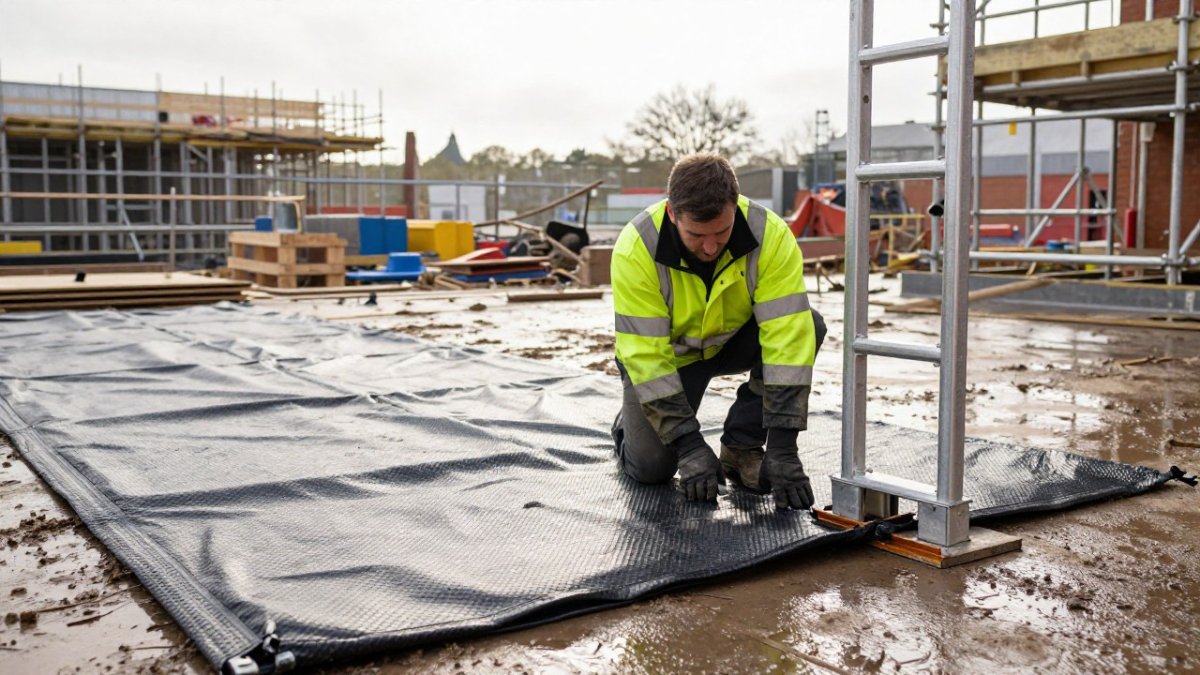
- Confirm the ground can take the equipment's weight
- Check the equipment is certified and the operator is competent
- Plan rescue and emergency arrangements
- Record the findings and review them on site
Do not skip step three. Soft ground under a loaded tower is a genuine danger. Work out the platform height you need first, using our guide to choosing the correct platform height, so your assessment and your equipment match.
Match the Access Equipment to Your Building and Book Your Tower
Matching access equipment to the building is the whole job. Low to mid-rise with firm ground: a tower. Tall with hard standing: a MEWP. High-rise with no footprint: rope access. Get the match right and the clean is safer, faster and cheaper.
At Leader Pro Scaffold Towers, we supply aluminium towers. Our manufacturer-direct model offers competitive pricing, and we provide next-day UK delivery and a comprehensive range of spare parts.
Ready to sort your access? Browse the Leader Pro 250 industrial scaffold tower in the height you need, or get in touch for advice on the right tower for your building. Shop now and get the right platform under your feet.
Frequently Asked Questions
What access equipment is used for high-rise window cleaning?
The main options are scaffold towers, mobile elevating work platforms (MEWPs) such as boom and scissor lifts, rope access, and suspended platforms or building maintenance units. Each suits a different combination of height, ground conditions and facade design.
Are scaffold towers suitable for high-rise window cleaning?
Always check the manufacturer's maximum platform height and never exceed it.
When should a MEWP be used for window cleaning?
Use a MEWP for window cleaning when the facade is too high for a tower but ground conditions allow a machine to be positioned safely. Boom lifts reach over obstacles such as planters and low roofs, while scissor lifts suit flat, firm surfaces and straight facades. You need trained operators, a rescue plan and a ground survey for slopes, drains and buried services. MEWPs also avoid the assembly time a tower requires on every move.
What safety checks are needed before working at height?
A working at height risk assessment should come first, covering the task, the height, the ground, the weather and who else is affected.
Picking access equipment for a high-rise job is where safety and cost collide. Leader Pro Scaffold Towers makes that choice simpler with certified towers, manufacturer-direct pricing and fast delivery. Get started with Leader Pro Scaffold Towers and put a safe, stable platform on your next window cleaning contract.