 How-to
7 Steps to Repair Minor Aluminium Scaffold Damage Safely
Last Updated: November 21, 2026
Quick Summary
To repair minor aluminium scaffold damage safely, isolate the tower, assess each defect against the manufacturer's instructions, and replace any bent, cracked or seized part rather than straightening or welding it. Permitted repairs are limited to swapping manufacturer-approved parts such as frame clips, base plates and adjustable legs, followed by a competent-person check before the tower returns to service.
- Isolate the tower and photograph each defect before moving any parts.
- Replace bent frames and braces, because straightening changes the metal's properties.
- Welding, drilling new holes and substituting non-standard clips are prohibited fixes.
- Complete a defect report template for every repair, however small.
- A competent person must confirm the tower is fit for use before it returns to service.
Table of Contents
- Step 1: Isolate the Tower and Assess the Aluminium Scaffold Damage
- Step 2: Follow the Aluminium Scaffold Tower Inspection Checklist
- Step 3: Know the Scaffold Tower Inspection Frequency That Applies
- Step 4: Decide Between Repair and Replacement of Damaged Scaffold Tower Parts Replacement
- Step 5: Carry Out Permitted Repairs and Avoid Prohibited Fixes
- Step 6: Complete a Scaffold Tower Defect Report Template After Any Repair
- Step 7: Return the Tower to Service with a Competent-Person Check
- Order Replacement Parts from Leader Pro Scaffold Towers
- Frequently Asked Questions
Step 1: Isolate the Tower and Assess the Aluminium Scaffold Damage
Minor aluminium scaffold damage is any defect that affects a component's appearance or function without compromising the tower's overall structural integrity, such as a bent brace, a stiff adjuster leg, or a worn frame clip. Before you touch a single part, isolate the tower and record exactly what you find.
Rushed assessments often take more towers out of service than the original defect does. Clear the platform, remove tools and materials, and bar entry with physical barriers and a tag. Then work through the tower methodically: check every frame, brace, clip, base plate and adjustable leg in good light.
- Note the part name, its position on the tower and the type of damage
- Photograph each defect before you move anything
- Separate cosmetic marks from anything bent, cracked or seized
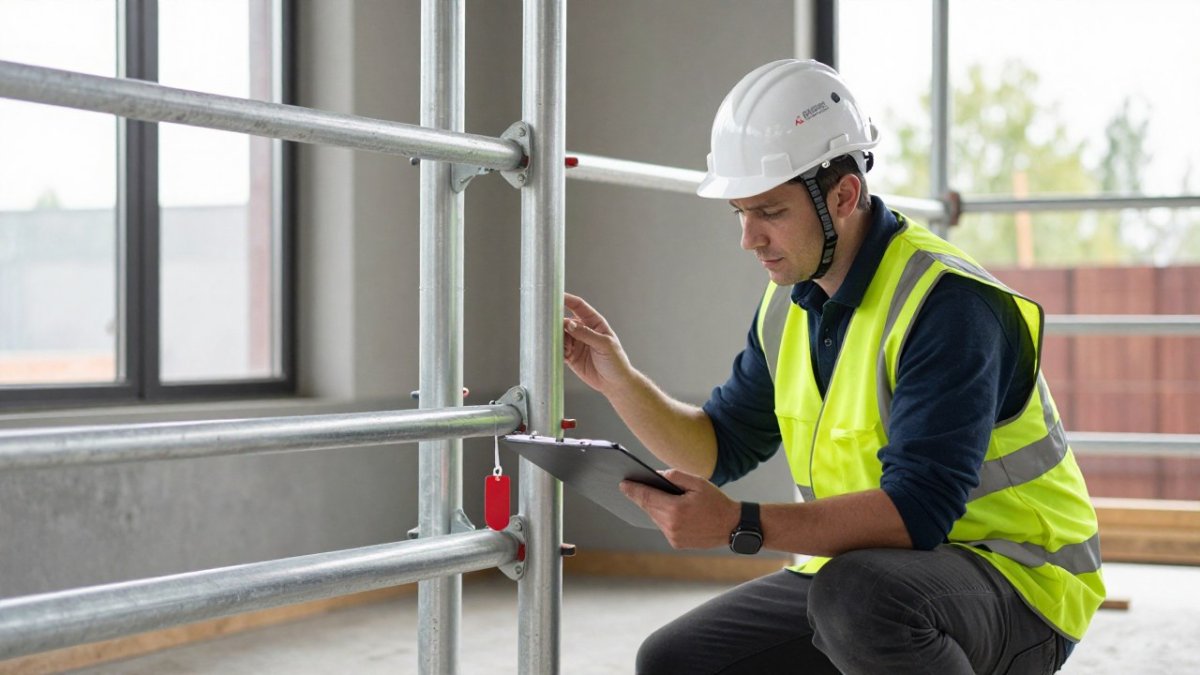
Watch out: working on or around a tower that has not been formally isolated is a common cause of avoidable incidents. Tag it out first, every time.
Step 2: Follow the Aluminium Scaffold Tower Inspection Checklist
A structured aluminium scaffold tower inspection checklist turns guesswork into evidence. Work top to bottom and record each item as pass, monitor or fail.
Start with the frames and braces: look for bends, dents, cracks and elongation around clip holes. Move to the locking clips and check they engage fully and spring back. Inspect base plates for distortion and adjustable legs for free movement and clean threads. Check platforms for splits and missing trap doors, and guardrails for secure fitment. Confirm the tower is level and the stabilisers are fitted as the manufacturer specifies.
Any fail item comes off the tower before it goes back into use. For the underlying safety and standards guidance behind this checklist, see our Safety & Standards guides.
Step 3: Know the Scaffold Tower Inspection Frequency That Applies
Scaffold tower inspection frequency is not a single fixed interval. It depends on use, environment and the manufacturer's instructions. A tower in daily use on a busy site needs checking before each shift, while a tower standing idle for weeks still needs a documented check before anyone climbs it.
Set your own schedule around three triggers:
- Before every use: a quick visual check of clips, legs and platforms
- After any event: a full inspection following impact, high winds or a move between locations
- At fixed intervals: a recorded inspection at a frequency your risk assessment and manufacturer guidance support
Record each inspection with date, inspector and outcome. If you are unsure what interval applies to your tower, the Health and Safety Executive guidance on working at height sets out the risk-assessment principles to follow, and your manufacturer's manual is the final word on component checks.
Step 4: Decide Between Repair and Replacement of Damaged Scaffold Tower Parts Replacement
Damaged scaffold tower parts replacement is the safer default whenever a component's strength or fit is in doubt.
Work through the component groups below. For each, the question is not whether the damage looks minor, but whether the part can still do the job it was designed for.
Frames and braces. A bent frame or brace has yielded, the aluminium has passed its elastic limit and will not spring back to its original geometry.
Locking clips and joints. A clip that does not engage fully, does not spring back, or is cracked or missing is a replacement item.
Adjustable legs and base plates. A seized or bent adjustable leg cannot be safely reworked, the thread and pin are precision features, and forcing them damages the leg further. Replace it.
Platforms and guardrails. A platform with a split, a missing trap door, or a distorted hook is a replacement item. Guardrails with bent tubes or damaged fittings should be replaced rather than straightened.
Castors. A castor that does not swivel freely, has a flat spot, or has a damaged brake is a replacement item. Castors are safety-critical on a mobile tower and are not repairable in the field.
Cracks. A crack anywhere is a replacement trigger. Cracks propagate under load, and a crack that looks stable at rest can grow quickly once the tower is in service.
| Defect | Typical Decision | Why |
|---|---|---|
| Bent brace or frame | Replace | Straightening changes the metal's properties |
| Seized or bent adjustable leg | Replace | Thread and pin damage cannot be safely reworked |
| Worn or missing frame clip | Replace | A clip is a cheap, quick swap |
| Distorted base plate | Replace | Load transfer depends on a flat, sound plate |
| Scuff or cosmetic mark | Monitor | No effect on strength or fit |
| Crack anywhere | Replace | Cracks propagate under load |
| Damaged castor or brake | Replace | Safety-critical on a mobile tower |
| Split platform or missing trap door | Replace | Platform integrity cannot be restored in the field |
Where the manufacturer's instructions permit a specific repair, for example, replacing a clip or a leg with the correct spare, follow them exactly. For a full picture of how each component fits together, browse our components guides.
Step 5: Carry Out Permitted Repairs and Avoid Prohibited Fixes
Permitted repairs are limited to swapping manufacturer-approved parts and following the maker's assembly instructions. Prohibited fixes include welding, drilling new holes, straightening bent aluminium, and substituting non-standard clips or bolts.
Welding. Aluminium loses strength when heated, and the heat-affected zone around a weld is no longer the part it was certified as.
Drilling new holes. Drilling a new hole for a clip or pin changes the load path through the component and creates a stress concentration at the hole edge.
Straightening bent aluminium. Bending a part back by force works the metal and can introduce cracks that are not visible at the surface. A straightened brace or frame may appear to fit but will not carry load as designed.
Substituting non-standard clips or bolts. A clip or bolt that is not the specified part may not engage fully, may not have the correct strength grade, or may not fit the mating component.
Improvised fixes. A cable tie, tape, or unmatched bolt is not a repair. If the correct part is not to hand, keep the tower out of service until it arrives.
Permitted repairs are therefore narrow and component-specific:
- Frame clips: replace with the correct clip for your tower model, such as a LEADER PRO 250 scaffold tower frame clip. Confirm the clip engages fully and springs back before returning the tower to service.
- Base plates: replace a distorted plate with a galvanised steel base plate of the correct size and fitting for your tower.
- Adjustable legs: replace a bent or seized leg with a 500mm adjustable leg of the correct thread and pin configuration.
- Castors: replace a damaged castor with the manufacturer's specified castor, and confirm the brake operates correctly.
- Platforms and guardrails: replace damaged items with the correct platform or guardrail for your tower model; do not attempt to repair splits or bends.
Fitting a replacement is straightforward: isolate the tower, remove the failed part, fit the correct replacement, and confirm it locks and seats properly.
Watch out: a "temporary" fix with a cable tie, tape or an unmatched bolt is how a minor defect becomes a serious one.
Step 6: Complete a Scaffold Tower Defect Report Template After Any Repair
A scaffold tower defect report template is the record that proves what was found, what was done and who signed it off. Complete it for every repair, however small.
Use this structure:
- Tower ID and location
- Date and name of the person reporting
- Defect description with the component and position
- Action taken: part replaced, part number, or tower withdrawn
- Repair completed by and date
- Post-repair check outcome and competent-person sign-off
Keep the completed report with the tower's inspection records. If the tower is audited on site, this document is your evidence that the repair was controlled and the part was correct. It also flags repeat defects on the same component, which usually points to a handling or assembly issue rather than bad luck.
Step 7: Return the Tower to Service with a Competent-Person Check
A tower goes back into service only after a competent person confirms it is fit for use. Competence here means the training and experience to recognise defects and judge whether a repair is sound, not simply seniority.
The return-to-service check should confirm:
- Every replaced part is the correct specification and fully seated
- All clips engage and lock
- The tower is level, with stabilisers and outriggers fitted as specified
- Platforms, guardrails and toe boards are complete
- The defect report is signed and filed
If anything is uncertain, the tower stays out of service. Our towers are built to BS EN 1004 standards for mobile access towers, and the manufacturer's assembly instructions remain the reference for correct configuration. A short, documented check now prevents a much longer interruption later.
Order Replacement Parts from Leader Pro Scaffold Towers
Keeping a small stock of the parts that fail most often, frame clips, base plates and adjustable legs, means a minor defect costs you hours rather than days. Leader Pro Scaffold Towers supplies replacement parts for our towers, backed by expert product advice and fast next-day delivery.
Order the correct part the first time: check your tower's model, match the component, and fit it to the manufacturer's instructions. If you are unsure which part you need, our team will help you identify it before you buy.
Minor aluminium scaffold damage only becomes a serious problem when it is ignored or badly repaired. Leader Pro Scaffold Towers gives you the parts and support to put a tower back into safe service quickly: manufacturer-direct pricing, a comprehensive range of spare parts, and BS EN1004-certified towers backed by expert advice. Get started with Leader Pro Scaffold Towers and keep your access equipment working safely.
Frequently Asked Questions
Can a damaged aluminium scaffold tower be repaired?
Minor aluminium scaffold damage, such as a small dent in a guardrail or a bent toe board, can sometimes be repaired or the affected part replaced. Structural components like uprights and braces that are bent, cracked or deeply dented should be replaced rather than straightened. Always check the manufacturer's instructions and have a competent person confirm the tower is safe before it returns to service. If in doubt, take the tower out of use.
Can a bent aluminium scaffold tube be straightened?
Straightening a bent aluminium tube is not a permitted repair on a BS EN1004 tower. Aluminium loses strength when bent and does not recover it when forced back into shape, so a straightened tube can fail under load. The correct action is to remove the bent component and fit a genuine replacement part. Record the damage on your defect report and keep the tower out of service until the part is swapped.
When should a damaged scaffold tower be taken out of service?
Take a tower out of service immediately if any load-bearing part is bent, cracked, corroded or has a deep dent, if a weld is cracked, or if the tower is unstable or missing components. Tag it clearly, isolate it from use and report the damage. Minor cosmetic issues on non-structural parts may allow continued use only after a competent person has assessed it and confirmed it is safe.
How often should an aluminium scaffold tower be inspected?
Inspect before every use, after any event that could affect stability such as a strong wind or impact, and at intervals set by your risk assessment. Some sites set a formal inspection cycle for towers in continuous use, based on their own risk assessment. A documented aluminium scaffold tower inspection checklist keeps records consistent and shows due diligence if you are audited on site.