 Ultimate guide
BS EN1004 Scaffold Tower Requirements Explained
Table of Contents
- What BS EN1004 Scaffold Tower Requirements Actually Cover
- Height Classes and Platform Limits Under BS EN1004
- Guardrails, Toe Boards and Platform Load Requirements
- How the PASMA 3T Method Fits BS EN1004 Tower Use
- Building a Scaffold Tower Inspection Checklist for Site
- Work at Height Regulations 2005 and Scaffold Tower Compliance
- Mistakes That Put BS EN1004 Compliance at Risk
- Frequently Asked Questions
Last Updated: 14 September 2026
What BS EN1004 Scaffold Tower Requirements Actually Cover
BS EN1004 scaffold tower requirements are the European product standard that defines how mobile access towers must be designed, manufactured, tested and marked before they can be sold for professional use. If a tower does not meet the standard, it is not a compliant working platform, whatever the supplier's sales page claims.
This guide breaks down what the standard actually demands, where the 3T method fits, and how to build an inspection routine that survives a site audit. Below, we cover the height classes, load limits, guardrail rules and the mistakes that quietly put compliance at risk.
The headline change most buyers miss is structural. BS EN 1004 was split into two parts, and the older single-document approach is gone. BSI guidance on BS EN 1004-1 and 1004-2 confirms the standard now separates materials, dimensions and design loads from the assessment and selection process. In practice, that means a tower can be manufactured to one part of the standard and still be selected or assembled incorrectly under the other. Compliance is not a sticker. It is a chain.
The key changes in BS EN 1004-1 and 1004-2
Part 1 sets the product requirements: materials, dimensional tolerances, structural design, stability and the test methods a manufacturer must run. Part 2 covers how towers are assessed, selected and used, including the information that must reach the end user. The split matters because it puts more responsibility on the person specifying the tower, not just the factory that built it.
A common mistake is treating the two parts as interchangeable. They are not. You need both: a tower built to Part 1, and a selection and assembly process that follows Part 2.
Height Classes and Platform Limits Under BS EN1004
BS EN1004 sorts towers into height classes that dictate the maximum platform height you can work from, and those limits are tied to whether the tower is used indoors or outdoors. Outdoor use carries tighter restrictions because wind loading changes everything.
The practical rule is simple: never assume a tower rated for a given height indoors is cleared for the same height outside. The standard distinguishes between the two, and the marking on the tower tells you which class you have. Check the label before you climb, not after.
What most guides miss is that height class is not just about the top platform. It governs how many platforms you can install, the bracing pattern, and the stabiliser or outrigger configuration. A tower assembled to the right height but the wrong bracing pattern is out of compliance even if it looks stable.
Guardrails, Toe Boards and Platform Load Requirements
Guardrails, toe boards and platform loading are the three areas where BS EN1004 compliance is most often tested on site. The standard specifies guardrail heights, the number of rails, and the toe board dimensions that prevent tools and materials from being kicked off the platform.
Platform load capacity is where assumptions get expensive. The standard sets design loads for the platform, and exceeding them, whether through stacked materials or too many people, compromises the structure. A tower is not a storage rack.
- Guardrails must be fitted at the specified heights on every open side
- Toe boards must sit flush to the platform edge with no gaps
- Load limits apply per platform, not per tower
- Never mix components from different tower systems
Mixing parts from different manufacturers is a quiet killer. Components are designed as a system, and a brace that fits does not mean a brace that is rated for that tower.
How the PASMA 3T Method Fits BS EN1004 Tower Use
The PASMA 3T method is the assembly sequence that keeps tower erection and dismantling compliant with the standard: Transport, Test, Tie. It is the practical bridge between what BS EN1004 requires and what actually happens on site.
Transport means moving components to the assembly point in a controlled way, keeping the platform clear as you build. Test means checking stability and the locking mechanisms before anyone climbs. Tie covers the bracing and stabiliser configuration that gives the tower its rigidity.
PASMA guidance on mobile access tower assembly is the recognised training route for this method, and many sites now require a PASMA card before anyone touches a tower. If your team is assembling towers without that training, the standard is not the problem. The assembly is.
Building a Scaffold Tower Inspection Checklist for Site
A scaffold tower inspection checklist is the document that proves your tower was checked before use, and it is the first thing an auditor asks for. Build it around the standard, not around habit.
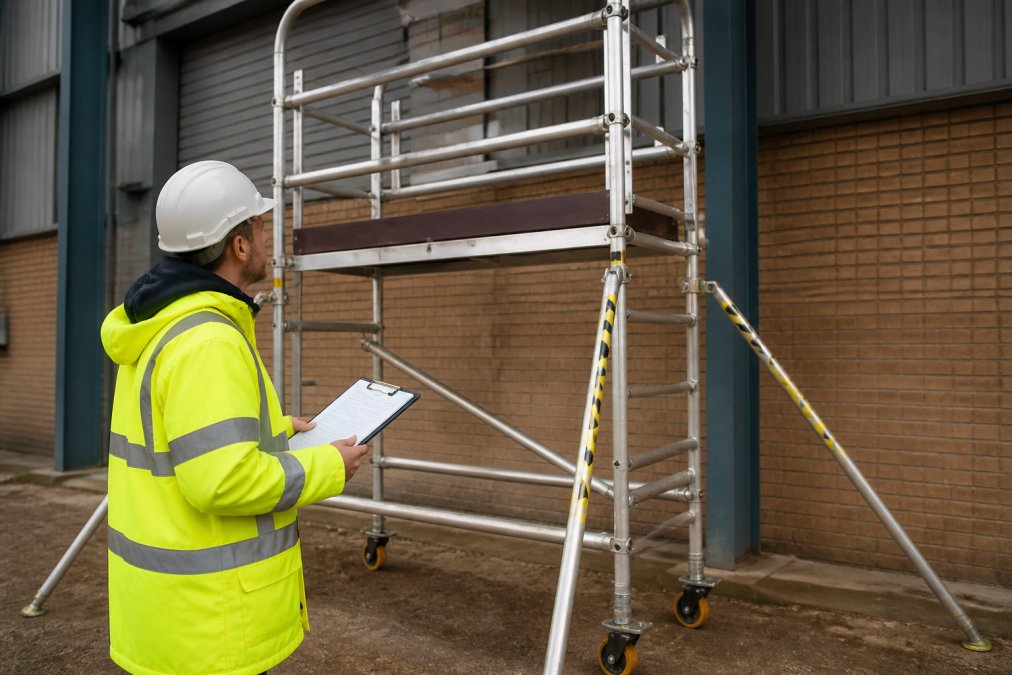
A workable checklist covers the same ground every time:
- Tower marked with the correct BS EN1004 class and load rating
- All guardrails, toe boards and platform boards fitted and locked
- Stabilisers or outriggers deployed to the configuration in the manufacturer's manual
- Wheels or base plates locked and the tower level
- No mixed components from different systems
- Inspection recorded with date, name and any defects found
The checklist should live with the tower, not in an office folder. If a site manager cannot see the last inspection record at the point of use, the record may as well not exist.
Work at Height Regulations 2005 and Scaffold Tower Compliance
The Work at Height Regulations 2005 are the legal layer sitting above BS EN1004. The standard tells you what a compliant tower looks like; the regulations tell you that you must plan the work, select the right equipment, and ensure anyone working at height is competent.
The regulations require that work at height is avoided where possible, and where it cannot be avoided, that it is properly planned, supervised and carried out by competent people. A BS EN1004 tower is the equipment half of that duty. Competence, planning and inspection are the other half.
HSE guidance on the Work at Height Regulations 2005 sets out the employer's duties in plain terms, and it is worth reading alongside the standard rather than instead of it. A compliant tower in the hands of an untrained assembler is still a non-compliant operation.
Mistakes That Put BS EN1004 Compliance at Risk
The same failures show up again and again on site, and almost none of them are about the tower itself.
| Mistake | Why it happens | The fix |
|---|---|---|
| Using an indoor tower outdoors | Height class ignored | Check the marking before assembly |
| Mixing components between systems | Parts look compatible | Keep one manufacturer's system per tower |
| Skipping the pre-use inspection | Time pressure | Log every inspection at the point of use |
| Overloading the platform | Materials stored on top | Enforce per-platform load limits |
| No PASMA-trained assembler | Training seen as optional | Require a card before anyone erects |
The pattern is consistent: the tower is rarely the weak link. The process around it is. That is why the standard splits product requirements from selection and use, and why an audit will look at both.
Leader Pro Scaffold Towers supplies aluminium towers built to BS EN1004, with manufacturer-direct pricing and next-day delivery, plus the spare parts that keep a tower in service rather than parked up waiting for a replacement brace.
Frequently Asked Questions
What is the current BS EN 1004 standard for scaffold towers?
BS EN 1004 has been split into two parts: BS EN 1004-1 covers materials, dimensions, design loads, safety and performance requirements, while BS EN 1004-2 covers the structural design calculations. Together they set the rules for mobile access towers, including platform widths, guardrail heights, load classes and stability. If you buy a tower that claims BS EN1004 compliance, the manufacturer should be able to show test evidence against both parts.
What are the height restrictions for mobile scaffold towers under BS EN 1004?
BS EN 1004 groups towers into height classes. Class 3 allows a platform height up to 3 metres, Class 4 up to 4 metres, and Class 5 up to 5 metres. For outdoor use, the standard assumes a maximum wind speed of 46 km/h (roughly 12.8 m/s), and taller towers need additional stabilisers, ballast or outriggers. Always follow the manufacturer's instruction manual for your specific tower, because indoor and outdoor limits can differ.
Who is responsible for ensuring scaffold tower compliance on site?
Under the Work at Height Regulations 2005, the duty holder, typically the employer, contractor or person in control of the site, must ensure equipment is suitable, inspected and used correctly. In practice that means checking the tower is BS EN1004 compliant, that assemblers are trained (PASMA or equivalent), and that pre-use checks are recorded. If something goes wrong, the paper trail matters as much as the tower itself.
What should be on a scaffold tower inspection checklist?
A practical scaffold tower inspection checklist should cover the platform deck condition, guardrails and toe boards, locking mechanisms, wheels and brakes, stabilisers or outriggers, and the overall level of the ground. Check for bent tubes, missing pins or damaged welds. Inspections should happen before every use and after any event that could affect stability, such as a move or high winds. Record the date, inspector's name and any faults found.
Compliant access at height comes down to three things: the right tower, assembled the right way, inspected every time. Leader Pro Scaffold Towers builds its range to BS EN1004, backs it with manufacturer-direct pricing, fast next-day delivery and a full stock of spare parts, and offers expert product advice before you buy. Shop now and get a tower that stands up to the standard and the audit.