 Ultimate guide
Preventing Falls in Retail Distribution Centres: A Guide
Quick Summary
Preventing falls in retail distribution centres depends on a documented risk assessment, clear walkways, the right access equipment for each task, and trained staff. Most falls come from rushed work, unsuitable ladders, cluttered aisles and uninspected equipment, and all are preventable.
- Falls from height and same-level slips, trips and falls are the two main groups of incidents.
- The Management of Health and Safety at Work Regulations 1999 require employers to assess risks and record significant findings.
- Walk the site and map every location where someone could fall from height or on the same level.
- Use a stable scaffold tower instead of a ladder for longer tasks, heavier loads or work needing both hands.
- Lock tower wheels, fit stabilisers where required and never move a tower while someone is standing on it.
Table of Contents
- Why Falls Happen in Retail Distribution Centres
- Warehouse Fall Prevention Risk Assessment: Where to Start
- Distribution Centre Housekeeping Checklist for Aisles and Walkways
- Working at Height in Warehouses Safely
- Scaffold Tower Safety in Warehouses
- Training Staff and Keeping Equipment Inspected
- Putting Your Fall Prevention Plan Into Practice
- Frequently Asked Questions
Why Falls Happen in Retail Distribution Centres
Falls from height and on the same level remain among the most common causes of serious injury in UK warehouses and distribution centres, which makes preventing falls a priority for every site.
Most falls in a distribution centre fall into two groups. The first is falls from height, usually from ladders, mezzanines, picking platforms or scaffold towers. The second is slips, trips and falls on the same level, caused by spillages, loose packaging, cables across walkways or poorly lit aisles.
The usual causes are predictable:
- Rushed work under pressure. Peak periods push staff to reach for stock rather than fetch equipment.
- Unsuitable access equipment. Using a stepladder where a stable tower is needed, or standing on the top rungs of a ladder.
- Cluttered walkways. Pallet wrap, cardboard and dropped items turn aisles into trip hazards.
- Inadequate training. Staff who have never been shown how to set up or move equipment safely often improvise.
- Uninspected equipment. Worn feet, missing locking pins or damaged platforms may go unnoticed until something fails.
The most dangerous moment is often the simplest task: a quick reach to a high shelf with the wrong equipment. Treating every height-related task as a planned job, rather than an improvised one, changes the outcome. A tower should never be moved while someone is still standing on it.
Warehouse Fall Prevention Risk Assessment: Where to Start
A risk assessment is the foundation of any fall prevention plan. Under the Management of Health and Safety at Work Regulations 1999, employers must assess risks to employees and others, and record the significant findings.
Start by mapping where people work above ground level and where they walk on the same level, since preventing falls depends on knowing exactly where the risks sit. Walk the site with a clipboard and note every location where someone could fall. Pay particular attention to goods-in areas, picking zones, mezzanines and loading bays.
Then work through a simple sequence:
- Identify the hazards. List each task that involves height, along with each walkway and floor area that is regularly congested.
- Decide who could be harmed. Consider permanent staff, agency workers, drivers and visitors.
- Evaluate the risk. Rate each hazard by likelihood and severity, and note existing controls.
- Record and act. Write down the controls you will introduce, who is responsible and by when.
- Review regularly. Revisit the assessment after any incident, layout change or new equipment purchase.
Involve the people who do the work. Operatives often know which ladders are unstable, which aisles flood and which tasks are done in a hurry. Their input usually produces a more accurate assessment than a manager working from a desk.
Distribution Centre Housekeeping Checklist for Aisles and Walkways
Good housekeeping prevents a surprising number of same-level falls. Clean, clear walkways are cheap to maintain, and the effort pays back quickly. Use this checklist as a starting point for daily and weekly inspections.
- Walkways and emergency routes are clear of pallets, packaging and equipment
- Spillages are cleaned up immediately and the area is signed while wet
- Stretch wrap, strapping and cardboard offcuts are binned, not left on the floor
- Cables and hoses are routed out of walkways or protected with cable covers
- Floor markings and pedestrian routes are visible and in good condition
- Lighting is working in aisles, stairways and loading areas
- Floor surfaces are inspected for cracks, lips and loose edging
- Waste bins are placed where they will not create obstructions
- Ladders, towers and step stools are stored in their designated place after use
Make housekeeping a shared responsibility at shift handover. A quick walk-through at the start and end of each shift catches most problems before they cause harm.
Working at Height in Warehouses Safely
Working at height covers any task where a person could fall from one level to a lower one, including tasks below ground level. The Work at Height Regulations 2005 set out the legal duties here, and they require work at height to be properly planned, supervised and carried out by competent people (The law).
The regulations follow a clear hierarchy. Avoid work at height where you can. Where you cannot, prevent falls using appropriate equipment. Where a fall cannot be fully prevented, minimise the distance and consequences of a fall (Step-by-step guide). Apply that hierarchy to every task before reaching for a ladder.
For many warehouse tasks, the right equipment is a stable, purpose-built access tower rather than a ladder. Choosing the right equipment for each task is the key decision.
Choosing Between a Ladder and a Scaffold Tower
A ladder suits short, low-risk tasks where the user can keep three points of contact and where the work involves only brief access. A scaffold tower suits longer tasks, heavier loads and any work where someone needs both hands free and a stable platform. Here is a simple guide:
| Task | Better option | Why |
|---|---|---|
| Brief one-off reach to a low shelf | Ladder | Quick to place and move |
| Restocking a bay for several minutes | Scaffold tower | Larger, stable platform |
| Work with tools or heavy items | Scaffold tower | Lower risk of overbalancing |
| Work in a congested aisle | Scaffold tower with stabilisers | Feet and stabilisers spread the load |
| Electrical or live-equipment work | Non-conductive GRP tower | Reduces the risk of conduction |
When in doubt, choose the option with the larger, more stable working base. Never use a stepladder as a platform, and never stand on the top rung of a ladder.
Scaffold Tower Safety in Warehouses
Scaffold towers are widely used in warehouses because they are quick to assemble and offer a stable working platform. They only protect people when they are erected, used and maintained correctly.
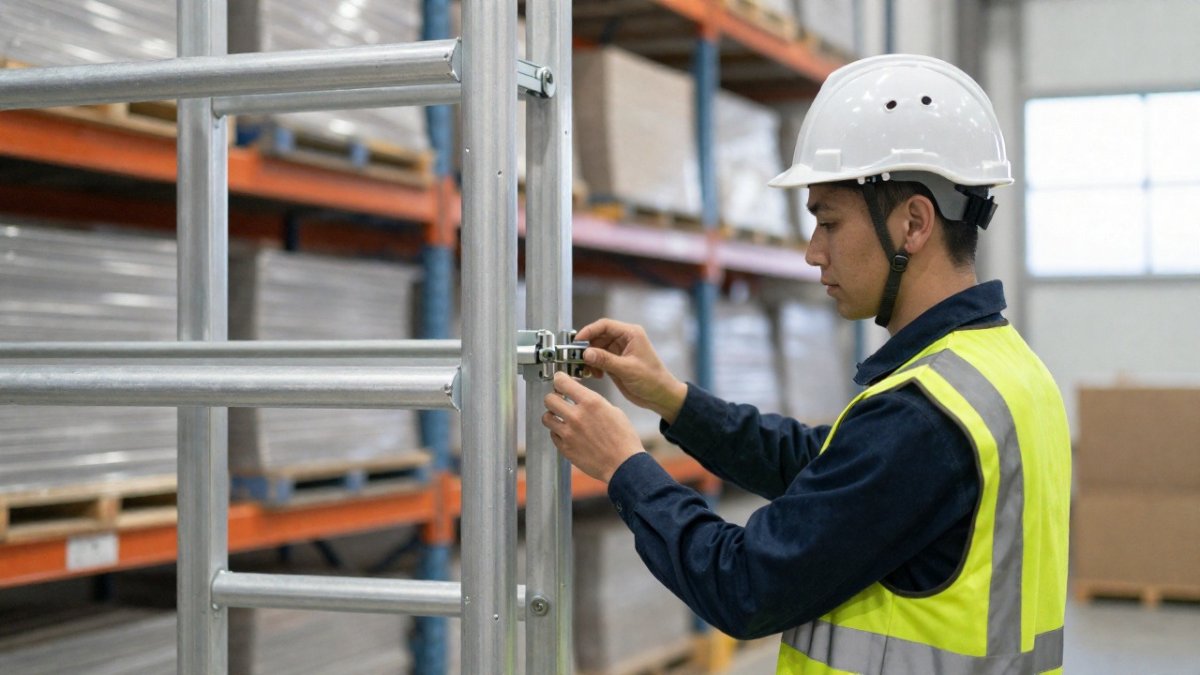
Before each use, check the tower against this sequence:
- Stand the tower on firm, level ground, and check that the base is not sitting on loose or uneven surfaces.
- Fit stabilisers where the manufacturer requires them, particularly on any tower that exceeds its recommended height ratio.
- Lock all castors or wheels before anyone climbs on.
- Inspect the locking pins, guardrails and toe boards for damage before use.
- Keep the platform clear of tools and materials that could fall or trip the user.
- Never move a tower while someone is standing on it.
The Health and Safety Executive recommends that scaffold towers are erected by competent people, with the manufacturer's instructions followed closely (Tower scaffolds). Operatives should be shown how to read the tower's rated load, height ratio and any specific restrictions. If a frame needs replacing, a single-width span frame is designed to match the existing tower system.
Here is an example of how this works on a real site. A picker needs to restock a high bay with a stable working platform for a short task.
Training Staff and Keeping Equipment Inspected
Equipment only protects people when they know how to use it. Training should cover risk awareness, correct selection of access equipment, safe erection and use, and how to report damage. Refresh training regularly, and always provide it when new equipment or new layouts are introduced.
Recognised training schemes are useful for setting a benchmark. Recognised training schemes, such as those run by PASMA, can help demonstrate competence in erecting and using mobile access towers. Keep records of who has been trained, on what, and when it needs renewing.
Equipment also needs a regular inspection regime. Build a simple system:
- Before each use: a quick visual check by the user for damage, missing parts and secure locking.
- Regular formal inspection: a documented check by a competent person at intervals set by your risk assessment.
- Tag and remove: any damaged equipment should be tagged out of use and removed from the work area until repaired or replaced.
- Keep records: inspection logs help show that the system works and make defects easier to trace.
Used equipment deserves particular attention. Check the manufacturer's markings, confirm the equipment is complete, and make sure it is compatible with the rest of your system before it goes into service.
Putting Your Fall Prevention Plan Into Practice
A fall prevention plan only works if it is put into practice. Start by setting clear, achievable actions with named owners. Prioritise the hazards with the highest risk and the simplest fixes, such as clearing walkways, replacing damaged ladders and introducing a pre-use check.
Communicate the plan to everyone on site, including agency workers. Display the key rules where people work, and make reporting near misses easy and blame-free. Near misses are early warnings; treating them seriously is one of the most effective ways to prevent a serious fall.
Review progress monthly at first, then at least every quarter. Track incidents, near misses, inspection results and training completion. If the numbers are not moving in the right direction, revisit the risk assessment and ask the people doing the work what is getting in the way.
If you are planning new access equipment or need advice on choosing a stable tower for warehouse work, the team at Leader Pro Scaffold Towers can help you match equipment to your tasks. You can shop the LEADER PRO 2.0m x 0.85m GRP 4 Rung Single Width Ladder Frame for compatible single-width access, or browse the LEADER PRO 2.5m Fixed Platform for a stable working deck.
Frequently Asked Questions
How can falls be prevented in a retail distribution centre?
Preventing falls in a retail distribution centre rests on three things: a documented risk assessment, a consistent housekeeping routine that keeps aisles and walkways clear, and safe access equipment used by trained staff. Start by mapping where people walk, climb and carry loads, then address the highest-risk areas first. Mark trip hazards such as pallet wrap, damaged floor edging and spilt stock, and set clear rules for when a ladder or tower is the right choice. Review the plan after any incident or change in layout.
What are the most common causes of falls in distribution centres?
Slips and trips on debris, spilt liquids and loose packaging are among the most frequent causes, followed by falls from ladders, pallets and mezzanine edges. Poor lighting, cluttered aisles and rushed work during peak periods increase the risk. Many incidents involve people reaching above shoulder height without a stable platform, so choosing the right access equipment matters as much as keeping floors clear.
When should a scaffold tower be used instead of a ladder?
A scaffold tower is generally the safer choice when a task needs more than a few minutes at height, requires both hands, or involves moving materials along a fixed platform. Ladders suit short, light tasks where three points of contact can be maintained. Check the working platform height, the stability on level ground and the manufacturer's guidance before use. Towers should always be assembled and used in line with the manufacturer's instructions and relevant British Standards.
How often should access equipment be inspected?
Access equipment should be inspected before each use as part of a quick visual check, and more thoroughly at intervals set by your risk assessment and the manufacturer's guidance. Look for bent or cracked components, missing pins, worn feet and damaged platforms. Remove any faulty equipment from service and label it clearly. Keep a record of inspections so you can show a competent person has reviewed the equipment.
What should a workplace fall-prevention risk assessment include?
A useful assessment identifies each task involving work at height or slip and trip exposure, lists who is at risk and how, and records the controls already in place. It should then rate the remaining risk and set out actions, owners and deadlines. Cover aisles, loading bays, mezzanines, racking and access equipment. Under the Work at Height Regulations 2005 and the Management of Health and Safety at Work Regulations 1999, employers must plan, supervise and review this work, so update the assessment whenever layouts or processes change.