 How-to
How to Conduct a Warehouse Height Safety Audit
Last Updated: 30 October 2026
Quick Summary
A height safety audit checks whether work above ground level in a warehouse is planned, equipped and supervised properly. It covers towers, ladders, platforms and fall-protection systems, plus the routines around them. A five-step audit covers scope, hazards, risk scoring, equipment inspection and reporting.
- Map every work-at-height task, its location, equipment used and how often it happens.
- Score each hazard by likelihood and severity on a 1 to 5 scale, then multiply the two.
- Ratings of 15 to 25 need immediate action, with the task stopped or equipment isolated.
- Work through the hierarchy: avoid work at height, prevent falls, then minimise the fall.
- Record each finding with an owner, a due date, an interim control and a verification step.
Table of Contents
- Why a Warehouse Height Safety Audit Matters and What It Covers
- Step 1: Define the Scope and Map Every Work-at-Height Task
- Step 2: Identify Hazards and the People Who May Be Harmed
- Step 3: Run a Working at Height Risk Assessment and Score Each Risk
- Step 4: Inspect Access Equipment, Racking and Traffic Routes
- Step 5: Record Findings in a Working at Height Audit Report
- Booking Your Next Audit Step: Replacing Worn Towers and Setting Review Dates
- Frequently Asked Questions
Why a Warehouse Height Safety Audit Matters and What It Covers
A height safety audit checks whether the work done above ground level in your warehouse is planned, equipped and supervised properly. It looks at the towers, ladders, platforms and fall-protection systems people use, and at the routines around them.
Working at height carries some of the highest risks in the warehouse. Falls from height are a significant cause of serious injury in workplaces (Work-related fatal injuries in Great Britain). The Health and Safety Executive publishes guidance on the Work at Height Regulations 2005, which set out the duties employers and those in control of work have (see HSE guidance on working at height).
This guide from Leader Pro Scaffold Towers walks you through a five-step audit you can run yourself. It covers scope, hazards, risk scoring, equipment inspection and reporting, and ends with how to act on what you find.
Step 1: Define the Scope and Map Every Work-at-Height Task
Start by listing every task that takes place above ground level. Picking orders from high racking, restocking mezzanines, cleaning light fittings and servicing dock doors all count. Walk the site and write each task down with its location.
- Note the equipment used for each task, such as a mobile tower, ladder or podium
- Record how often each task happens and who carries it out
- Mark the areas where people work at height during peak and quiet periods
A clear map stops tasks slipping through the gaps. It also tells you where to focus your time.
Step 2: Identify Hazards and the People Who May Be Harmed
For each task, ask what could go wrong and who could be hurt. The obvious answer is the person working at height, but forklift drivers, pickers and visitors on nearby walkways can also be struck by falling objects or equipment.
Common hazards include:
- Unstable or unlevelled tower bases
- Missing guardrails, toe boards or locking pins
- Uneven or cluttered floors around the equipment
Watch out: A tower that looks stable can tip when someone reaches sideways or when a forklift nudges it. Check the base and wheels every time it is moved.
Step 3: Run a Working at Height Risk Assessment and Score Each Risk
Score each hazard by how likely it is to cause harm and how serious that harm could be. A simple 1 to 5 scale for each is a practical approach. Multiply the two numbers to get a risk rating, then rank the hazards from highest to lowest.
- Likelihood (1-5): how often the hazard meets a person. A missing guardrail on a tower used twice a day scores higher than the same defect on a tower used twice a year.
- Severity (1-5): how badly someone could be hurt. A fall from a mezzanine edge is likely to be more severe than a trip on a ladder rung.
- Risk rating: likelihood multiplied by severity, giving a score from 1 to 25.
Worked example
A picker uses a mobile tower to reach high racking in an aisle shared with forklift traffic. The tower has a missing mid rail on one side.
- Likelihood: 4 (the tower is used most shifts and the missing rail faces the aisle)
- Severity: 5 (a fall from height onto a concrete floor could be fatal)
- Risk rating: 20
That score puts the finding in the immediate-action band. The tower is taken out of service, the rail is replaced, and the aisle is reviewed for pedestrian segregation before the tower returns.
By contrast, a faded load notice on a racking bay in a quiet corner might score likelihood 2 and severity 2, giving a rating of 4, a planned action for the next maintenance window.
Prioritisation bands
Use bands so the action list is consistent across auditors:
- 15-25: Immediate. Stop the task or isolate the equipment. Correct before work resumes. Notify the site manager the same day.
- 8-14: Urgent. Correct within 24-48 hours. Interim controls may be needed, for example, restricting access to an area until a guardrail is refitted.
- 1-7: Planned. Log for the next maintenance window and review at the next audit.
Apply the hierarchy of controls
The Work at Height Regulations 2005 require you to avoid work at height where reasonably practicable, prevent falls where work at height cannot be avoided, and minimise the distance and consequences of a fall where falls cannot be prevented (Assessing all work at height). In practice that means working through the hierarchy in order:
- Avoid the need to work at height, for example, use long-handled tools or bring the task to ground level.
- Prevent falls, use a safe platform with guardrails, such as a mobile tower or a fixed mezzanine edge protection system.
- Minimise the fall, where prevention is not reasonably practicable, use fall-arrest equipment such as a harness and lanyard, with rescue arrangements in place.
Training and procedure sit at the bottom of the hierarchy. They support the engineering controls but do not replace them. A common audit finding is a site that relies on "be careful" instructions when a guardrail or platform would have removed the risk entirely.
Assign owners and deadlines
A risk rating without an owner and a date is just a number. For every finding above the planned band, record:
- Action owner: the named person responsible, not a department.
- Due date: a specific date, not "next month".
- Interim control: what is in place until the fix is complete, for example, the equipment is locked away or the area is barriered.
UK legal context
The Management of Health and Safety at Work Regulations 1999 require employers to carry out suitable and sufficient risk assessments and to record the significant findings where five or more people are employed. The Work at Height Regulations 2005 sit on top of that for work at height. Specific operational tasks such as cleaning require a tailored working at height risk assessment to address the unique hazards posed by equipment and debris.
Step 4: Inspect Access Equipment, Racking and Traffic Routes
Now check the physical condition of the equipment and the areas around it. Use a checklist and mark each item pass or fail. The key is to record what you actually see, not what you assume.
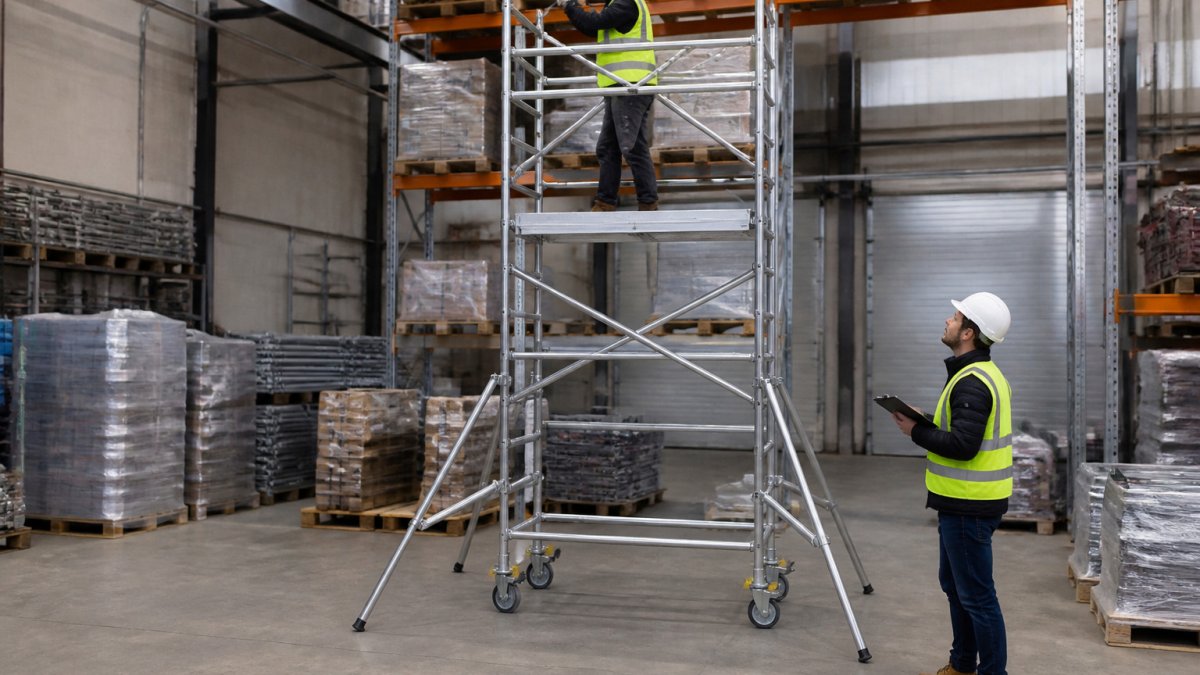
Mobile access towers and podiums
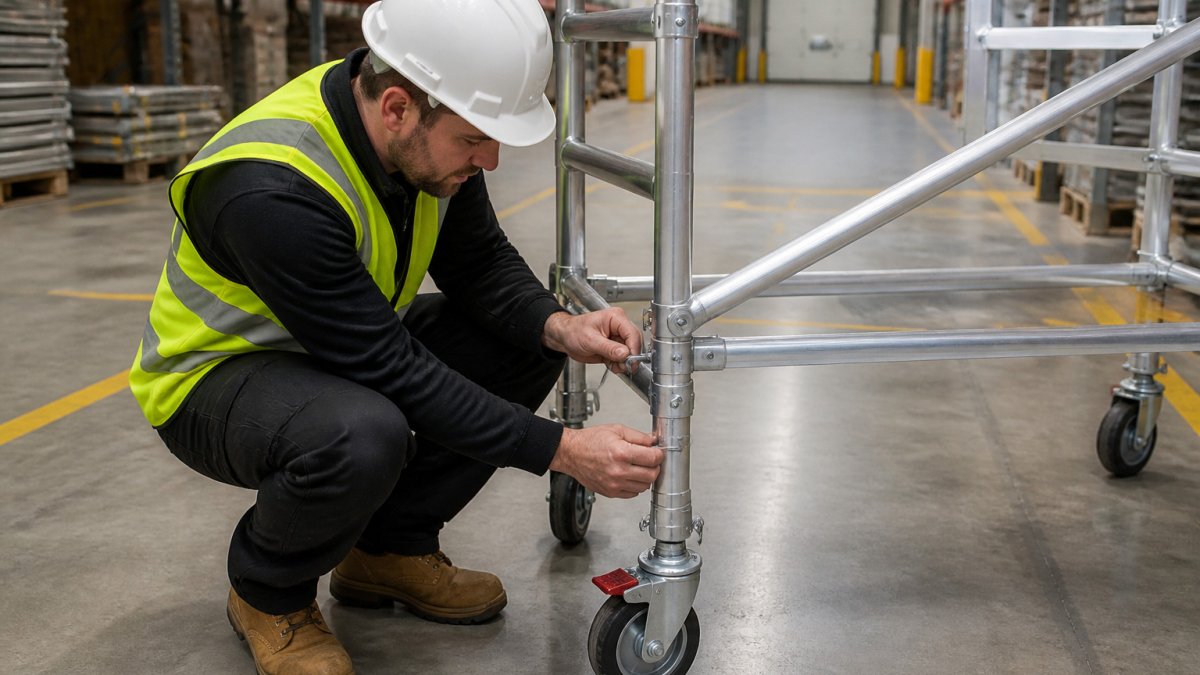
Inspect towers against the manufacturer's instruction manual and the current UK guidance from the Prefabricated Access Suppliers' and Manufacturers' Association (PASMA). Your inspection should confirm the tower was built to a recognised configuration in line with the manufacturer's instructions.
- Feet, wheels and brakes: all four castors present, brakes engaged and holding, wheels free of flat spots or debris. Fail if any brake will not lock or a wheel is missing.
- Guardrails and toe boards: top rail, mid rail and toe board fitted on every platform edge, including the ends. Fail if any rail is bent, missing or secured with tape or cable ties rather than the correct clips.
- Locking pins and bracing: all locking pins engaged and clipped, horizontal and diagonal bracing in place. Fail if a pin is missing, a clip is broken or bracing is loose.
Pass example: a tower with all four brakes locked, intact guardrails and toe boards on every edge, all locking pins clipped, and stabilisers fitted as per the manual. Fail example: a tower with a bent guardrail, one missing wheel lock, or a platform height above the rated limit. Fail items go straight onto the action list and the tower is taken out of service until corrected.
Ladders and step ladders
Ladders are often the first thing people reach for, but they are only suitable for low-risk, short-duration tasks. Inspect against the manufacturer's markings.
- Stiles and rungs: no cracks, splits, bends or missing rungs. Fail if any rung is loose or the stiles are bowed.
- Feet: non-slip feet present and in good condition. Fail if a foot is worn through or missing.
- Locking mechanisms: on step ladders, the spreader or locking bars engage fully. Fail if the ladder will not lock open.
Racking and storage systems
Racking inspection should follow the guidance in the Storage Equipment Manufacturers' Association (SEMA) code of practice for the use of racking, which classifies damage in a graded way that your audit can mirror.
- Beams: straight, correctly seated in the beam connectors, no dents or cracks at the end plates. Fail if a beam is bowed or the connector is deformed.
- Uprights: no splits, dents or corrosion at the base. Fail if an upright is bent or the base plate is lifting.
- Safety pins and clips: beam safety pins present and engaged. Fail if a pin is missing.
Traffic routes and loading bays
- Walkways: marked, clear and wide enough for the traffic using them. Fail if a walkway is blocked by pallets or equipment.
- Pedestrian segregation: physical barriers or marked routes separate people from forklift and pallet-truck movements. Fail if a pedestrian route crosses a vehicle route without a marked crossing point.
- Loading bays: wheel restraints or barriers in place, clear sightlines for drivers and pedestrians, and dock levellers in good condition. Fail if a wheel restraint is missing or a dock door will not close properly.
Escalation criteria
Not every fail is equal. Use three levels so the action list is proportionate:
- Immediate: stop work and isolate the equipment. Examples include a missing guardrail on an occupied platform, a red-class racking upright, or a tower with no brakes. Record who took the equipment out of service and when.
- Urgent (within 24-48 hours): repair or replace before the equipment is used again. Examples include a worn ladder foot or an amber-class racking beam.
- Planned: log for the next maintenance window. Examples include a faded load notice or a scuffed walkway marking.
Photograph every fail where you can, with a wide shot showing the location and a close-up showing the defect. The photos make the report clearer and help the people who fix them. Keep the inspection records, they are evidence that you checked, and they show whether defects are recurring in the same place.
The table below sets out the pass and fail checks for the main access equipment, drawn from the inspection points described in this section.
| Equipment | Check | Fail if |
|---|---|---|
| Mobile tower | Brakes and wheels | Any brake will not lock or a wheel is missing |
| Mobile tower | Guardrails and toe boards | A rail is bent, missing or taped rather than clipped |
| Mobile tower | Locking pins and bracing | A pin is missing or bracing is loose |
| Mobile tower | Platform height | Configured above the rated limit or stabilisers omitted |
| Ladder | Stiles and rungs | A rung is loose or the stiles are bowed |
| Ladder | Feet | A foot is worn through or missing |
| Racking | Beams | A beam is bowed or the connector is deformed |
| Racking | Safety pins and load notices | A pin is missing or the load notice is missing or out of date |
Step 5: Record Findings in a Working at Height Audit Report
Your audit report should be simple enough for a supervisor to act on. For each finding, record the location, a description, the risk rating, the action needed, who owns the action and a deadline.
- Date of the audit and the name of the auditor
- Each finding, with a photo reference where relevant
- Corrective action, owner and due date
Store reports where they can be found during a review or inspection. Repeat the audit on a regular schedule, and run an extra check after any incident, near miss, or change to the layout or equipment.
Booking Your Next Audit Step: Replacing Worn Towers and Setting Review Dates
Once you have your findings, the most common next step is replacing worn or damaged equipment.
Set review dates for each action now, not later. A finding without an owner and a deadline tends to sit on a list for months. Agree the date your next audit will happen, and put it in the diary before you finish this one.
Frequently Asked Questions
How often should work-at-height equipment be inspected?
Work-at-height equipment should be inspected before each use as part of a quick daily check, and formally examined by a competent person at intervals set by your risk assessment. Under the Work at Height Regulations 2005, equipment must be inspected after any event likely to have affected its safety, such as a knock, a change of location or a suspected defect. Most warehouses review their working at height audit at least annually, and sooner if incidents, near misses or layout changes occur. Keep dated records of every inspection so you can show the schedule was followed.
What should a warehouse height safety audit checklist include?
A useful warehouse safety audit checklist covers every work-at-height task, the access equipment used for it, the condition of guardrails, platforms and anchor points, racking uprights and beams, pedestrian and vehicle routes, and the training and competence of the people involved. Each item should have a clear pass or fail criterion, such as a tower with no missing locking pins or racking beams without visible deformation. Add a column for the action owner and a due date so findings lead to corrective action rather than sitting on paper.
What should you do after identifying a fall risk during an audit?
Apply the hierarchy of controls: first try to remove the need to work at height, then use equipment that prevents a fall, and only then rely on measures that limit the consequences of one. Stop the task if the risk is immediate, restrict access to the area, and record the finding with a risk rating based on severity and likelihood. Assign an action owner, set a completion date and check that the control works before closing the item in your inspection records.
What records should be kept after a warehouse safety audit?
Keep the audit date, the auditor's name and competence, the scope and locations covered, each hazard found with its risk rating, the corrective actions with owners and deadlines, and evidence that each action was completed. Include inspection records for access equipment, training records for staff who work at height, and any accident or near-miss reports linked to the audit. Retain these records in a form that can be produced quickly if the Health and Safety Executive or an insurer asks for them.