 How-to
How to Document Scaffold Inspections: Step-by-Step
Last Updated: 23 October 2026
Quick Summary
Document scaffold inspections by recording every check, defect and fix in writing on a standard form, so you can prove the tower was safe to use on the day. The Work at Height Regulations 2005 require a competent person to inspect working platforms at intervals not exceeding seven days and to keep a record of those inspections.
- Label every tower with a unique ID before its first inspection so records stay matched to the right structure.
- A routine weekly check takes 15-20 minutes per tower, and a pre-use visual check comes before every shift.
- Tick each checklist item as pass, fail or not applicable, because a blank box reads as not checked.
- Raise a separate defect report for every failed item and track it through to sign-off and re-inspection.
- Keep reports in date order per tower for as long as the tower is in use, and longer after an incident.
Table of Contents
- Why Documenting Scaffold Inspections Matters
- What You'll Need Before You Start
- Step 1: Confirm Your Scaffold Inspection Frequency
- Step 2: Work Through a Scaffold Inspection Checklist
- Step 3: Fill In a Scaffold Inspection Report Template
- Step 4: Raise a Scaffold Defect Report and Track Fixes
- Common Documentation Mistakes to Avoid
- Frequently Asked Questions
Why Documenting Scaffold Inspections Matters
Documenting scaffold inspections is the practice of recording every check, defect and fix on a scaffold tower in writing, so you can prove the structure was safe to use on the day.
The law is clear on this. The Work at Height Regulations 2005 require a competent person to inspect working platforms at intervals not exceeding seven days, and to keep a record of those inspections. The Health and Safety Executive guidance on scaffold inspection sets out what that record must contain.
So why does it matter in practice? Three reasons:
- Defence after an incident. A signed record shows the tower was checked and fit for use.
- Pattern spotting. Repeated defects on the same component point to a failing part, not bad luck.
- Handover clarity. The next crew knows exactly what state they inherited.
A missing record is not a paperwork slip. It is a gap in your safety case that an inspector will find.
What You'll Need Before You Start
Before you climb, get your kit together. A disorganised inspection produces a disorganised record.
Total time: 15-20 minutes per tower for a routine weekly check.
Here is what you need:
- A printed scaffold inspection checklist (or a tablet with a form app)
- A scaffold inspection report template with fields for date, time, tower ID, location and inspector name
- A tape measure and a spirit level
- A camera or phone for defect photos
- A tag system (green for safe, red for do not use)
- Access to the tower's assembly and handover records
- The name of the competent person carrying out the check
One insider point: label every tower with a unique ID before its first inspection. A record that says "the tower by the loading bay" is useless six months later when three towers have stood in that spot.
Step 1: Confirm Your Scaffold Inspection Frequency
Scaffold inspection frequency depends on the tower's use and conditions. The default rule is a formal inspection at least every seven days while the tower is in use. But seven days is a ceiling, not a target.
Inspect more often when:
- The tower has been moved, altered or partially dismantled
- High winds, heavy rain or frost have hit the structure
- The tower has been struck by plant or vehicles
- It stands on soft or sloping ground
- It has been out of use and is being brought back into service
A pre-use check by the user comes before every shift, regardless of the formal schedule. That check is visual and quick: guardrails, toe boards, platform fit, outriggers, stability. It does not replace the formal recorded inspection.
Log the frequency decision in your report template. If you inspected early because of a storm, write that down. The reason matters as much as the date.
Step 2: Work Through a Scaffold Inspection Checklist
A scaffold inspection checklist is a fixed list of items the competent person works through in the same order every time. The order is the point: it stops you skipping sections when you are cold, rushed or interrupted.
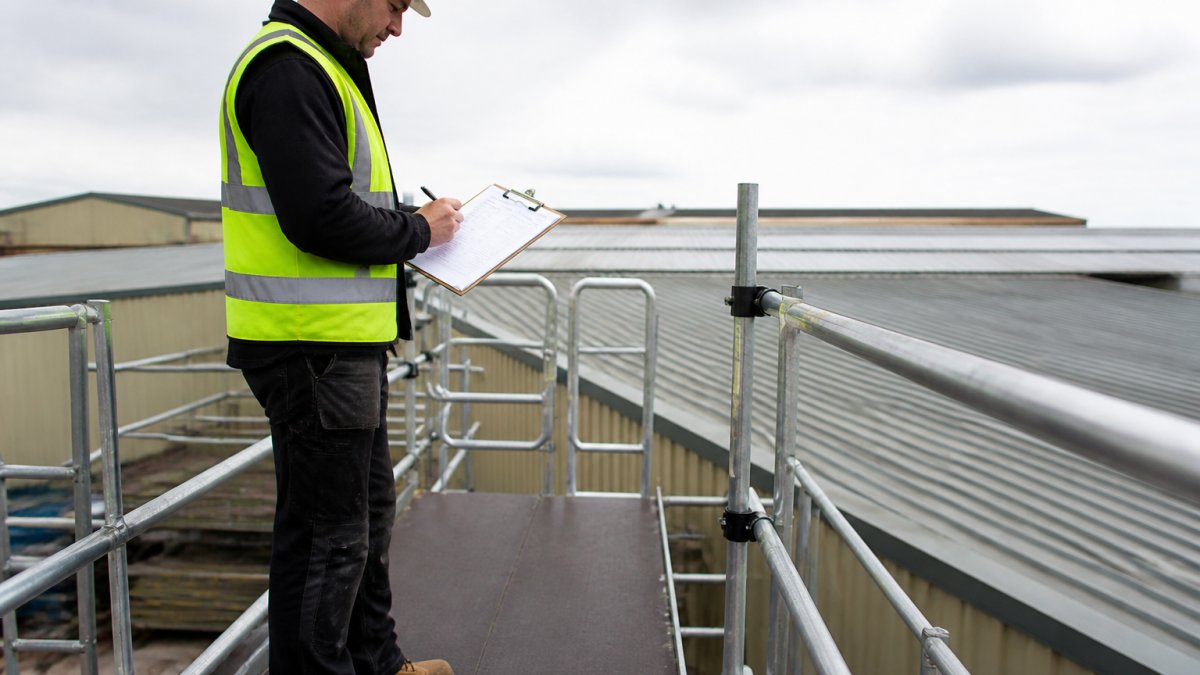
Work through these groups:
- Foundation and base. Adjustable legs seated and locked, base plates flat, ground firm and level.
- Structure. Verticals, horizontals and diagonals present, straight and undamaged.
- Clips and couplings. Frame clips engaged and locked, no missing or bent clips.
- Platforms. Decking fully seated, no gaps, trapdoors closed and secured.
- Guardrails and toe boards. Top rail, mid rail and toe boards in place at every level.
- Access. Ladder or stairway secure, internal where required.
- Stability. Outriggers or stabilisers fitted as specified, castors locked.
- Tags and signage. Current inspection tag visible, no red tag left on a tower in use.
Tick each item as pass, fail or not applicable. Never leave a box blank. A blank box reads as "not checked", and that is exactly how an inspector will read it. Our scaffold tower inspection checklist gives you the full item-by-item version to work through on site.
Step 3: Fill In a Scaffold Inspection Report Template
A scaffold inspection report template is a standard form that captures who inspected what, when, and what they found. Fill it in as you go, not from memory at the end of the day.
Every report should record:
- Date, time and duration of the inspection
- Tower ID and exact location on site
- Inspector name and role, confirming competent person status
- Weather and ground conditions at the time
- Checklist results, item by item
- Defects found, with location on the tower and a photo reference
- Actions taken or required, with a name and deadline
- Signature of the inspector
Keep it to one page per tower where you can. A form that takes twenty minutes to complete will get faked. A form that takes three minutes will get filled in honestly.
Store reports together, in date order, per tower. Digital forms make this easy; a ring binder by the site office door works just as well if everyone knows where it lives.
Step 4: Raise a Scaffold Defect Report and Track Fixes
A scaffold defect report is a separate record from the inspection report. The inspection says what state the tower is in. The defect report says what is wrong and who is fixing it.
Raise one whenever a checklist item fails. Include:
- Tower ID and the specific component at fault
- Description of the defect in plain terms ("near-side adjustable leg seized, cannot level")
- Photo of the fault
- Immediate action taken: tower red-tagged, section closed, or use restricted
- Assigned to and target fix date
- Sign-off when the fix is complete and re-inspected
The most common defects are seized or bent adjustable legs, missing frame clips, cracked platform boards and damaged guardrails. All of these are fixable fast if you hold the right spares. Keeping a small spares box on site turns a week of downtime into an afternoon.
Track every defect through to sign-off. An open defect report on a tower that is back in use is worse than no report at all. For guidance on replacing worn components, our maintenance guides cover the common repairs.
| Defect | Immediate Action | Fix | Sign-Off Needed |
|---|---|---|---|
| Seized adjustable leg | Red-tag tower, stop use | Replace leg, re-level | Yes, re-inspect |
| Missing frame clip | Restrict that section | Fit new clip | Yes, re-inspect |
| Cracked platform board | Remove board, close level | Replace decking | Yes, re-inspect |
| Bent guardrail | Red-tag tower, stop use | Replace rail | Yes, re-inspect |
| Loose castor | Lock or replace castor | Swap castor | Visual check |
Common Documentation Mistakes to Avoid
The biggest documentation mistake is treating the paperwork as an afterthought. Here is what we see go wrong most often.
- Back-filling reports. Writing up a week of inspections on a Friday afternoon. Dates and details blur, and it shows.
- No tower ID. Records that cannot be matched to a specific structure are worthless in an investigation.
- Blank boxes. A blank field is not a pass. It is an admission that nobody checked.
- Defects logged but never closed. An open defect on a live tower is a red flag.
- One person's handwriting on every form. If the same signature appears on inspections carried out on different sites at the same time, questions get asked.
- No retention plan. Keep records for as long as the tower is in use, and longer if an incident has occurred.
For the wider standards context behind inspection and record-keeping duties, our safety and standards guides set out what applies to aluminium towers.
Documenting scaffold inspections properly takes minutes, but it protects your crew, your site and your business. The teams that struggle are usually the ones without a standard form or a reliable supply of replacement parts. Leader Pro Scaffold Towers supplies BS EN1004-certified aluminium towers with manufacturer-direct pricing and next-day delivery, plus a full range of spare parts so a failed clip or leg never stalls a job. Get started with Leader Pro Scaffold Towers and keep every tower compliant, documented and ready to work.
Frequently Asked Questions
What should be included in a scaffold inspection record?
A complete record should identify the scaffold and its location, the date and time of inspection, and the name and competence of the inspector. It needs the findings from your scaffold inspection checklist, any defects found and the corrective actions taken, plus a signature confirming the scaffold is safe to use. Note the results of the first inspection after erection, any inspection following alteration or adverse weather, and the date of the next scheduled check. Keep records on site so they can be produced on request.
How often should scaffolding be inspected?
Scaffold inspection frequency depends on the circumstances. A scaffold should be inspected before first use, then at intervals not exceeding seven days while it remains in place. It also needs inspecting after any event that could affect its stability, such as high winds, impact damage or alterations. Record each inspection with the date and time so the seven-day cycle is easy to evidence. Short-lived scaffolds still need a first inspection before use, even if they come down within the week.
Who is competent to inspect a scaffold?
The inspector must have the training, knowledge and experience to identify faults that affect safety. In practice this usually means someone who has completed a recognised scaffold inspection course and understands the relevant standards, such as BS EN 1004 for mobile access towers. Competence is about more than a certificate: the person needs to recognise when a component is damaged, a tie is missing or a platform is incomplete. Keep a record of their training alongside your inspection paperwork.
How long should scaffold inspection records be kept?
Keep inspection records for as long as the scaffold is in use and for a reasonable period afterwards, so you can evidence compliance if an incident or inspection occurs. A common approach is to retain them for at least three months after the scaffold is dismantled, and longer for larger or long-running projects. Store them with your other health and safety documentation, either on site or in a central system. If a defect report led to repairs, keep that record with the inspection it relates to.