 How-to
How Do You Keep Warehouse Access Equipment Compliant?
Last Updated: November 13, 2026
Quick Summary
Keep warehouse access equipment compliant by inspecting it daily before use and monthly in depth, recording every check in a maintenance log, and removing any faulty tower from service until it is repaired. The Work at Height Regulations 2005 require equipment to be inspected, and BS EN 1004 covers mobile access and working towers.
- Carry out a quick daily inspection before each use, covering visible damage, locking pins and wheel brakes.
- Do monthly checks that look more closely at welds, joints and stabilisers, and record them.
- Record the tower ID, date, inspector, result and any parts replaced in a log for each check.
- Tag any faulty tower out of use at once and do not return it until the fault is fixed and checked.
- Replace the whole section of a badly damaged frame rather than patching it.
Table of Contents
- Why Maintaining Warehouse Access Equipment Matters for Compliance
- Know the Rules: Scaffold Tower Inspection Requirements in the UK
- Build Your Warehouse Access Equipment Inspection Checklist
- Carry Out Daily and Monthly Safety Inspections, Step by Step
- Maintaining GRP Scaffold Towers for Electrical and Utility Work
- Set Up an Access Equipment Maintenance Log That Stands Up to Audit
- Troubleshooting Common Equipment Failures and Removing Damaged Kit from Service
- Booking Your Next Equipment Check and Replacing Worn Parts
- Frequently Asked Questions
Keeping warehouse access equipment in good order is one of the simplest ways to protect your crew from falls and keep your site on the right side of the law. This guide walks you through what to check, how often to check it, and what to do when a tower fails inspection. Maintaining access equipment for safety compliance is less about heavy paperwork and more about a steady routine that anyone on site can follow.
Most warehouse access kit lives in the same place for years. Frames, stabilisers and wheels take knocks, get dragged across concrete and pick up grime. Small faults add up. A cracked locking pin or a bent brace can turn a safe platform into a hazard within a single shift.
Why Maintaining Warehouse Access Equipment Matters for Compliance
A well-kept access tower is a safe working platform. A neglected one is a liability. Regular checks catch problems early, before they reach the people working on top.
Compliance is about proof as much as practice. Inspectors and clients want to see that equipment was checked, recorded and removed from use when it was faulty. The routine below gives you both.
- Spot wear before it becomes a fall risk
- Show clients and inspectors a clear record
- Cut downtime by fixing parts early
- Protect your team and your reputation
Know the Rules: Scaffold Tower Inspection Requirements in the UK
In the UK, the Work at Height Regulations 2005 set the core duties for anyone using access equipment (The law). Employers must plan work at height, use suitable equipment and make sure it is inspected (The law). BS EN 1004 is the standard covering mobile access and working towers (British Standards Institution).
Inspection should happen before first use, after any event that could affect the tower, and at regular intervals set by a competent person. Check the manufacturer's guidance too, as it sets out the exact parts and load limits for your model.
Before you start, confirm which rules apply to your site and kit:
- The Work at Height Regulations 2005 and their duty to inspect equipment
- BS EN 1004 for the design of mobile access towers
- The manufacturer's instructions and load ratings
- Any site-specific rules your client sets
Build Your Warehouse Access Equipment Inspection Checklist
A checklist turns good intentions into a repeatable habit. Keep one copy on the tower or in your van, and make sure everyone knows where it is kept.
Your checklist should cover the parts that carry load and the parts that keep a tower stable:
- Frames and braces: no cracks, bends or missing pins
- Platform and guard rails: secure, with no damage to the deck
- Locking pins and clips: fully engaged and not worn
- Wheels and castors: rolling freely, with brakes that hold
- Stabilisers and outriggers: fitted correctly and in good condition
- Labels and load ratings: clear and readable
Carry Out Daily and Monthly Safety Inspections, Step by Step
Daily checks happen before each use. A quick walk around takes a few minutes and catches most visible faults. Monthly checks go deeper and suit a logbook entry.
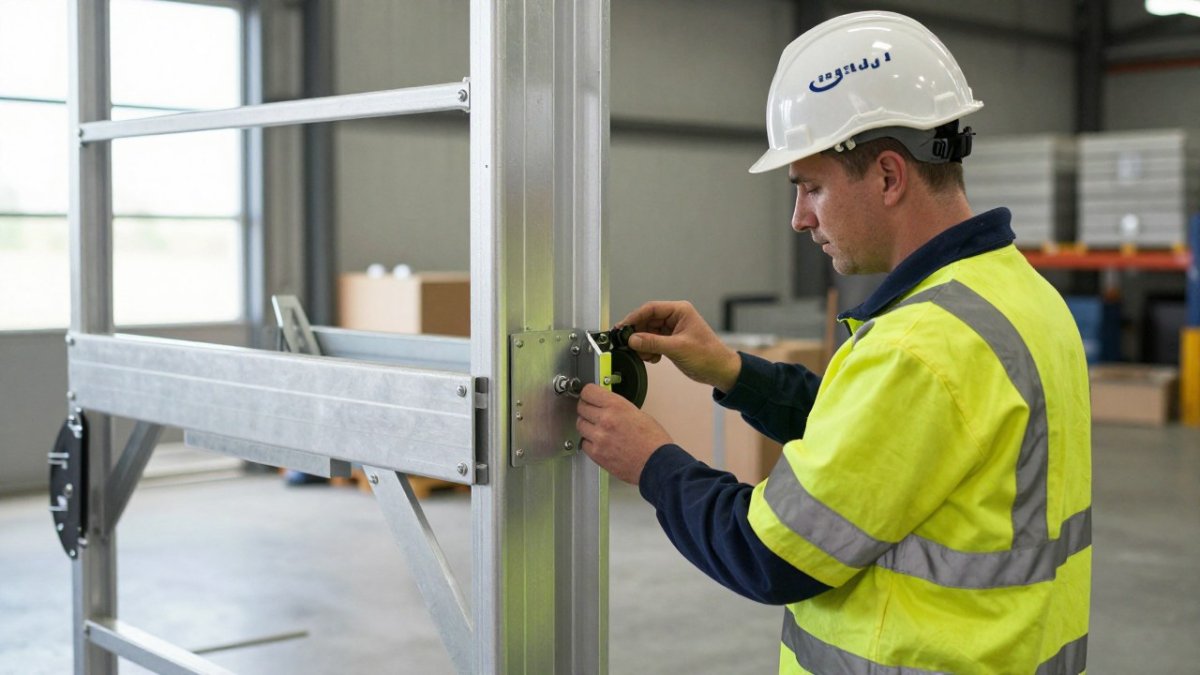
Follow these steps for a daily inspection:
- Look over the whole tower for visible damage.
- Check every locking pin and clip is in place.
- Test the wheel brakes on level ground.
- Confirm the platform sits flat and the guard rails are secure.
- Tag the tower as safe to use, or take it out of service.
Monthly checks add a closer look at welds, joints and the condition of any stabilisers. Record the date, the person who checked, and anything that needed action.
Watch out: a tower that looks fine can still have a worn pin or a hairline crack. If in doubt, take it out of service.
Maintaining GRP Scaffold Towers for Electrical and Utility Work
Glass-reinforced plastic (GRP) towers are generally chosen for electrical and utility jobs because they are non-conductive. Keeping them non-conductive depends on careful handling and regular checks.
Look for surface damage that could expose the core, and keep the tower clean and dry.
For work near live equipment, make sure your stabilisers and frames are non-conductive and in good condition before you start. Record every check in the same log as your aluminium towers.
Set Up an Access Equipment Maintenance Log That Stands Up to Audit
A maintenance log is your proof of compliance. Keep it simple, dated and up to date. Each tower should have its own entry, so you can trace its history.
Record these details for every check:
- Tower ID or serial number
- Date and time of the inspection
- Name of the person who inspected it
- Result: pass, fail or repair needed
- Any parts replaced and the date
- Sign-off before the tower returns to use
Store logs in a place that is easy to find during an audit. Digital copies work well, as long as they are backed up and cannot be changed without a trace.
Troubleshooting Common Equipment Failures and Removing Damaged Kit from Service
When a tower fails inspection, act at once. Tag it out of use, move it away from the work area, and record the fault in the log. Do not return it to service until the problem is fixed and checked.
Use this table to guide your response:
| Fault found | Likely cause | Action |
|---|---|---|
| Cracked frame or brace | Impact or overloading | Remove from service and replace the section |
| Worn locking pin | Repeated use or wear | Replace the pin before use |
| Wheel brake will not hold | Worn brake or debris | Clean or replace the castor |
| Bent guard rail | Knock or misuse | Take out of service and inspect the joint |
| Missing or unreadable label | Age or wear | Replace the label and check load rating |
If a frame is badly damaged, replacing the whole section is safer than patching it.
Booking Your Next Equipment Check and Replacing Worn Parts
Plan your next inspection before the current one ends. Diarise monthly checks and set reminders for any parts that wear fast on your site. Keeping spares on hand means a fault does not leave a tower idle for weeks.
For replacement stabilisers, frames and fittings, check the Leader Pro Scaffold Towers website for current prices or a quote, as pricing depends on quantity, delivery date and location.
Keeping your access equipment compliant does not need to be complicated. Build a simple checklist, inspect daily and monthly, log every result and remove faulty kit straight away. Leader Pro Scaffold Towers supplies aluminium and GRP towers and spare parts, with fast next-day UK delivery and expert product advice, so you can keep your kit in service with confidence. Visit our website to find the right parts for your towers.
Frequently Asked Questions
How often should warehouse access equipment be inspected?
Access equipment should be visually checked before each use, with a more thorough inspection by a competent person at regular intervals set by a risk assessment. Many warehouses carry out a formal inspection at least monthly, and always after any incident, alteration, or extended period out of use. Under the Work at Height Regulations 2005, equipment must be inspected at suitable intervals and records kept. Daily user checks catch most problems early, while the monthly inspection confirms that components such as couplers, bracing, platform boards, and wheels remain sound and that labels are legible.
What should be checked before using a mobile scaffold tower?
Before climbing a mobile scaffold tower, confirm that the stabiliser outriggers are fitted where the design requires, that the wheel brakes are locked, and that the tower is standing on firm, level ground with no debris underfoot. Check that all platform boards are secure, guard rails and toe boards are in place, and that the tower is within its rated working height and load. Look for cracked welds or bent frames, and confirm that the BS EN 1004 label and last inspection tag are present. If anything is missing or damaged, tag the tower as out of service and do not use it.
What should a warehouse access equipment inspection checklist include?
A practical checklist covers the frame and bracing, couplers and locking pins, platform boards and their fixings, guard rails, toe boards, ladder rungs, wheels and braking systems, outriggers, and any labels or load ratings. For GRP towers, add a check for surface cracking, delamination, and contamination that could affect non-conductive performance. Record the date, the inspector's name, the equipment ID, pass or fail for each item, and any remedial action taken. Keep a copy with the equipment or in the maintenance log so the record can be produced quickly if the site is inspected.
When should damaged access equipment be taken out of service?
Damaged access equipment must be taken out of service immediately, tagged clearly, and removed from the work area until it has been repaired by a competent person or replaced. Typical triggers include bent or cracked frames, damaged or missing locking pins, worn or split platform boards, missing guard rails, and any structural distortion. Do not attempt temporary fixes that the manufacturer has not approved. Log the defect, the date it was removed from service, and the date and outcome of the repair or replacement, so there is a clear audit trail.