 How-to
How to Report an Unsafe Scaffold Tower on Site
Last Updated: 29 October 2026
Quick Summary
Stop work immediately, get everyone off the tower, cordon off the base and tell the site supervisor. Then assess whether the unsafe scaffold tower is a minor fault or an imminent danger, gather photographic evidence, and report it in writing the same day. If there is immediate risk of serious harm, ring 999 and notify the HSE.
- Keep the exclusion zone clear to at least the tower's working height in every direction where space allows.
- Treat any fault you are unsure about as imminent danger, because over-reporting costs an hour while under-reporting risks serious injury.
- Never use an online form to report an emergency; ring 999 first and report in writing afterwards.
- Follow up your verbal report in writing the same day, as email timestamps the report and protects you.
- Health and safety disclosures are protected under the Employment Rights Act 1996, so you should not be penalised for raising a genuine danger.
Table of Contents
- Step 1: Stop Work and Make the Area Safe
- Step 2: Assess Whether It Is a Minor Fault or Imminent Danger
- Step 3: Collect Evidence Before You Report an Unsafe Scaffold Tower
- Step 4: Tell the Right Person on Site and Record It in Writing
- How to Report a Health and Safety Issue to the HSE
- What to Include in a Site Safety Report
- Scaffold Tower Inspection Frequency and the Inspection Checklist
- Scaffold Tower Inspection Checklist: What a Competent Person Looks For
- Frequently Asked Questions
Step 1: Stop Work and Make the Area Safe
Reporting an unsafe scaffold tower on site begins with one action: stop work immediately. No one should climb a tower that looks damaged, unstable or wrongly put together.
Here is the order we recommend:
- Stop all work on and near the tower.
- Get everyone off the platform and the access ladder.
- Cordon off the base with cones, barrier tape or temporary fencing.
- Tell the site supervisor straight away.
- Keep people clear until a competent person has looked at it.
The exclusion zone matters more than most people think. Falling materials and a collapse risk both start at the base.
Watch out: never "just finish the last bit" from a tower you already suspect is unsafe.
Step 2: Assess Whether It Is a Minor Fault or Imminent Danger
The decision that shapes everything else is simple: is this a minor fault or an imminent danger? Get this wrong in either direction and you either waste a day on paperwork or leave someone exposed to a collapse. A useful test is one question: could this hurt someone before the end of the shift?
Minor faults
A minor fault is a defect that degrades the tower but does not remove its ability to carry and protect people. Typical examples:
- A missing toe board on one platform level.
- A loose guardrail clip or a single missing pin.
- A castor that will not lock but is on a level, firm base.
A minor fault still takes the tower out of use until it is fixed. If you are unsure whether a fault stems from poor erection, our safe assembly guide explains the correct build sequence and checks. Log it, tag the tower, and get it repaired or re-assembled before anyone climbs again. Do not sign it back into service on a verbal assurance.
Imminent danger
An imminent danger is a condition where the tower could collapse, overturn or drop someone or something now. Treat any of these as imminent:
- Missing, loose or wrongly fitted stabilisers or outriggers.
- Cracked, bent or corroded standards, ledgers or braces.
- A tower built beyond its safe height for its base dimensions and stabiliser configuration. Check the UK height limits to confirm whether the tower is being used beyond safe parameters.
If you are unsure which side of the line a fault sits on, treat it as imminent. The cost of over-reporting is an hour of lost work; the cost of under-reporting is a serious injury.
The escalation ladder
Work up this ladder in order, and do not skip a rung because the one below it feels slow:
- Stop work and secure the exclusion zone, as covered in Step 1.
- Tell the site supervisor or principal contractor immediately and ask for the tower to be taken out of use.
- If people are at immediate risk of serious harm, call 999. A tower that is collapsing, has partially collapsed, or has dropped a person or material is an emergency. Do not wait for a site meeting.
- Notify the HSE using its incident contact arrangements for a dangerous occurrence, or its online reporting service for a non-emergency concern. The HSE's reporting routes are set out in its guidance on reporting incidents and accidents.
- If the structure is endangering the public, for example a tower overhanging a pavement or a boundary, contact the local council's building control team, who can act on dangerous structures.
Why the distinction matters legally
Reporting duties differ depending on what has happened. Where a dangerous occurrence has taken place, check the HSE's guidance on reporting incidents to confirm your obligations. A defect that has not caused harm still needs fixing and recording on site.
Step 3: Collect Evidence Before You Report an Unsafe Scaffold Tower
Evidence turns a complaint into a report someone can act on. Before you report an unsafe scaffold tower, gather clear proof while the scene is still as you found it.
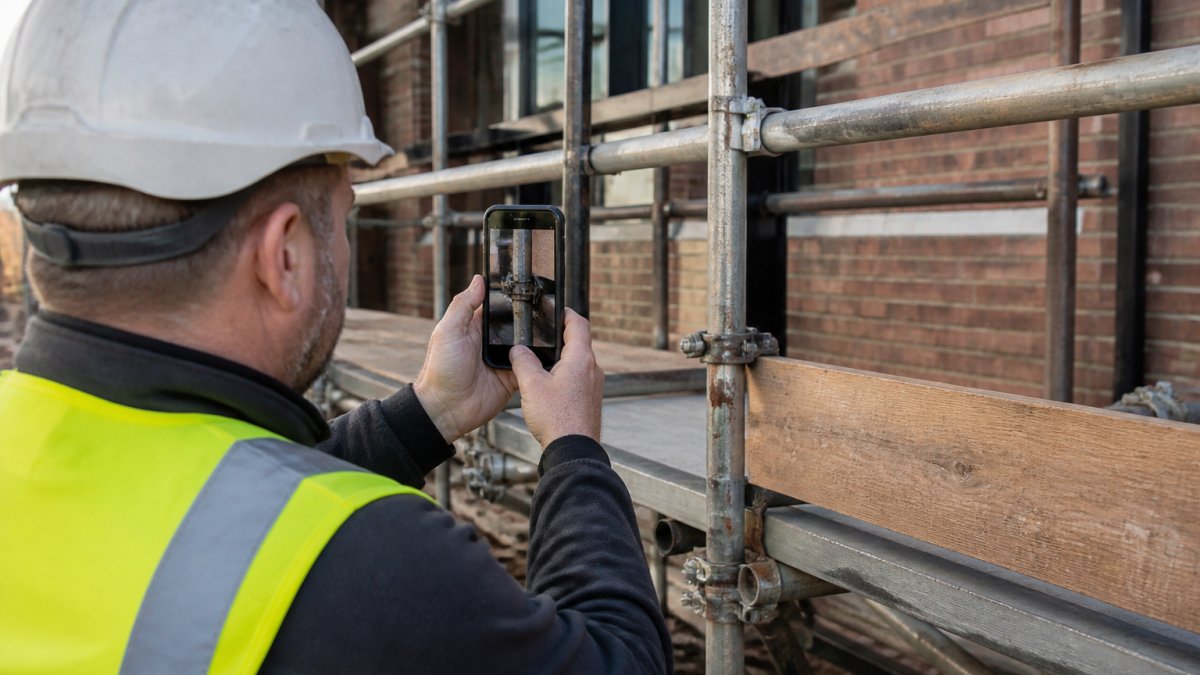
Capture these:
- Photos of the fault from several angles, plus one wide shot showing the whole tower.
- The tower's location on site and its unique tag or ID number.
- The date and time you spotted the problem.
Keep the photos on a work device, not a personal phone, and back them up. Note anything already done to make the area safe, such as barriers going up.
Step 4: Tell the Right Person on Site and Record It in Writing
Verbal reports get forgotten. A written record protects you and gets the fault fixed faster.
Tell the person in charge of the tower, usually the site supervisor or principal contractor. Then follow up in writing the same day.
Your written note should cover:
- What is wrong and where.
- When you found it and what you did to make it safe.
- The photos you attached.
Ask for confirmation that the tower has been taken out of use. If nothing happens, escalate to the site's health and safety lead.
How to Report a Health and Safety Issue to the HSE
Most unsafe tower issues should be fixed on site first. The HSE is there for cases the site will not resolve, or where there is a real risk of serious harm. Knowing which channel to use, and what protection you have for using it, is where most guides stop short.
Pick the right channel
The HSE runs more than one reporting route, and using the wrong one slows things down:
- Dangerous occurrences and serious incidents, a scaffold collapse, a partial collapse, or an incident where someone was injured, go through the HSE's incident contact arrangements and are reportable under RIDDOR. These have strict time limits, so report as soon as you reasonably can.
- Day-to-day safety concerns, a tower that is unsafe but has not yet caused harm, or a site that keeps ignoring defects, go through the HSE's online reporting service for concerns about a workplace.
- Dangerous structures endangering the public, a tower overhanging a pavement, a boundary or a public right of way, go to the local council's building control team, who have powers to deal with dangerous structures.
If you are not sure which applies, ring the HSE and ask. Being routed to the right team is faster than submitting to the wrong one.
What to send
A report that an inspector can act on contains:
- The site address and the company responsible, including the principal contractor if known.
- A clear description of the danger and where on site it is.
- Your evidence: photos, dates, times and witness names.
You can report anonymously, though giving contact details helps inspectors follow up and lets them tell you the outcome. Anonymous reports are still acted on, but they are harder to progress.
What happens after you report
The HSE triages reports and decides whether to inspect, write to the duty holder, or take no further action. You may not hear back quickly, and the HSE does not investigate every report.
Keep your own copy of everything you submit: the form confirmation, the date, and any reference number. If the situation escalates, that record shows you raised it.
Whistleblower protection: you are protected for reporting
This is the part most guides leave out, and it is the reason many workers stay quiet. If you report an unsafe scaffold tower, internally or to the HSE, you are a whistleblower, and you have legal protection.
Protection is not a guarantee of a smooth ride, and some workers still face pressure. If that happens, keep records of every conversation and contact the HSE or Acas for advice on your rights.
What to Include in a Site Safety Report
A strong site safety report is short, factual and easy to act on. It does not need jargon. It needs the facts a manager can check.
A good site safety report includes:
| Section | What to include |
|---|---|
| Location | Site address, exact position of the tower |
| Hazard | What is wrong and how serious it is |
| Evidence | Photos, dates, times, witness names |
| Action taken | Barriers, work stopped, people told |
| Request | Inspection, repair or removal |
| Sign-off | Name and role of the person receiving it |
Keep the tone neutral. Describe what you saw, not who you blame. That keeps the focus on fixing the hazard.
Scaffold Tower Inspection Frequency and the Inspection Checklist
Inspection frequency depends on use and conditions. A tower should be checked before first use, after assembly, and after any alteration.
For a tower in constant use, many sites inspect daily. For occasional use, a check before each session is sensible.
A simple inspection report should note:
- The tower's ID and location.
- Who inspected it and when.
- Any defects found.
These records are your proof of duty of care. For more inspection and compliance guidance, explore our safety & standards library.
Scaffold Tower Inspection Checklist: What a Competent Person Looks For
A competent person checks the tower against a fixed list, every time. That consistency is what catches problems early.
- Base is level, firm and free of soft ground.
- Stabilisers or outriggers are fitted and secure.
- No bent, cracked or corroded components. Our maintenance guides help you spot damage and defects before they become a problem.
Frequently Asked Questions
Who should I report an unsafe scaffold tower to on site?
Report it first to the site manager or the principal contractor, and to your own supervisor if you are subcontracted. Ask for the name of the person responsible for the scaffold and log the time you raised it. If the tower is in a public area or on a building you do not control, the duty holder is whoever commissioned the work. When nobody on site will act, you can report the unsafe scaffold tower to the HSE or your local council's building control team.
Should work stop if a scaffold tower is unsafe?
Yes. Work must not continue on equipment that is not stable or fit for purpose. Move everyone off the tower, keep others away with temporary fencing or barriers, and do not let anyone climb it to 'just check'. A tower missing guardrails, with a damaged brace or sitting on soft ground is a fall risk, and a fall from even a low platform can be fatal. Stopping work is always the correct first step.
How often should a scaffold tower be inspected?
A scaffold tower should be inspected before first use, and again after any event that could affect its stability, such as high winds, impact or alteration. Each inspection should be carried out by a competent person and recorded in a written report. Keeping to this scaffold tower inspection frequency is what turns a verbal 'it looked fine' into evidence you can rely on if something goes wrong.
Can I report a health and safety concern to the HSE anonymously?
You can raise a concern with the HSE without giving your name, though they may not be able to follow it up fully without contact details. The HSE generally expects you to have raised the issue with your employer first. Reports go through the HSE website or the phone line, and for a scaffold on or next to a public highway you should also contact the local council. Keep your own copy of everything you submitted.
An unsafe tower is a problem you can fix in an afternoon, but only if someone reports it properly. At Leader Pro Scaffold Towers, we build every tower to BS EN1004 standards, with manufacturer-direct pricing and fast next-day delivery, so you start from a safer base. Our range of spare parts keeps a good tower in service for years.
Get started with Leader Pro Scaffold Towers and give your team access equipment you can trust.