 Ultimate guide
Safe and Stable Working Platforms for Retail Logistics
Table of Contents
- Types of Working Platforms for Retail Logistics
- Work at Height Regulations 2005 Compliance
- PUWER Inspection Requirements for Access Equipment
- Risk Assessment for Working at Height in Retail
- Choosing Safe and Stable Working Platforms for Your Site
- Frequently Asked Questions
Last Updated: September 12, 2026
Types of Working Platforms for Retail Logistics
Safe and stable working platforms for retail logistics are height-access systems designed to let staff reach stock, racking and ceiling services without the instability of ladders or the cost of full scaffolding. In a retail warehouse or stockroom, the right platform is the one that matches the task height, the floor surface and the frequency of use.
This guide from Leader Pro Scaffold Towers breaks down the platform types, the regulations that govern them and the inspection regime that keeps them compliant.
Two broad categories cover most retail logistics work: mobile aluminium towers for anything above roughly 2.5 metres, and podium steps for low-level, high-frequency tasks. Getting that split right is where most sites go wrong.
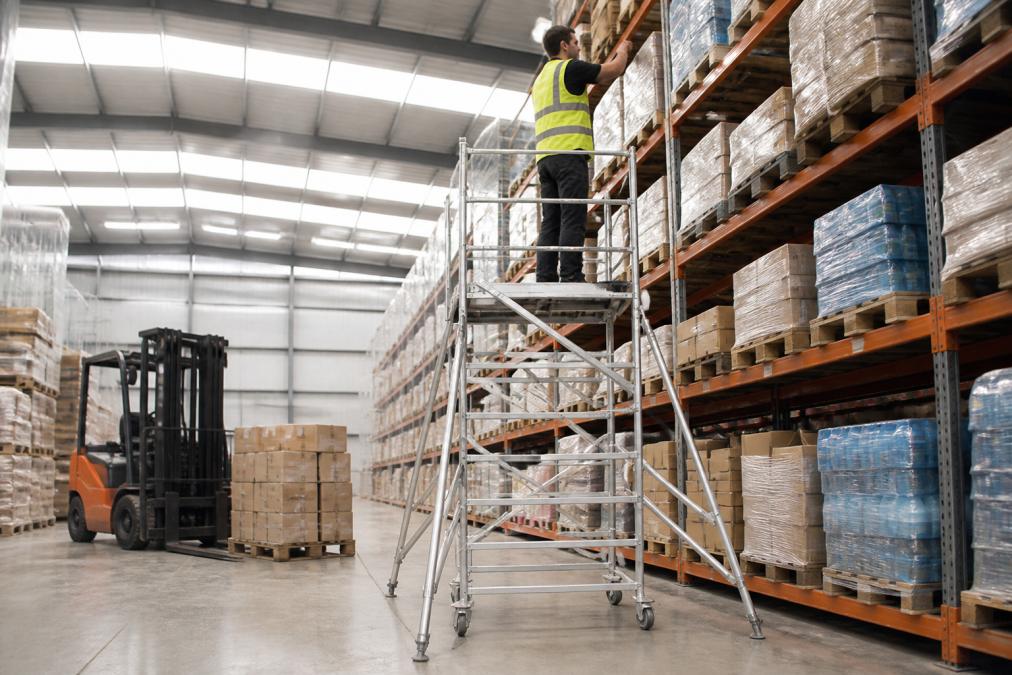
Mobile Aluminium Towers
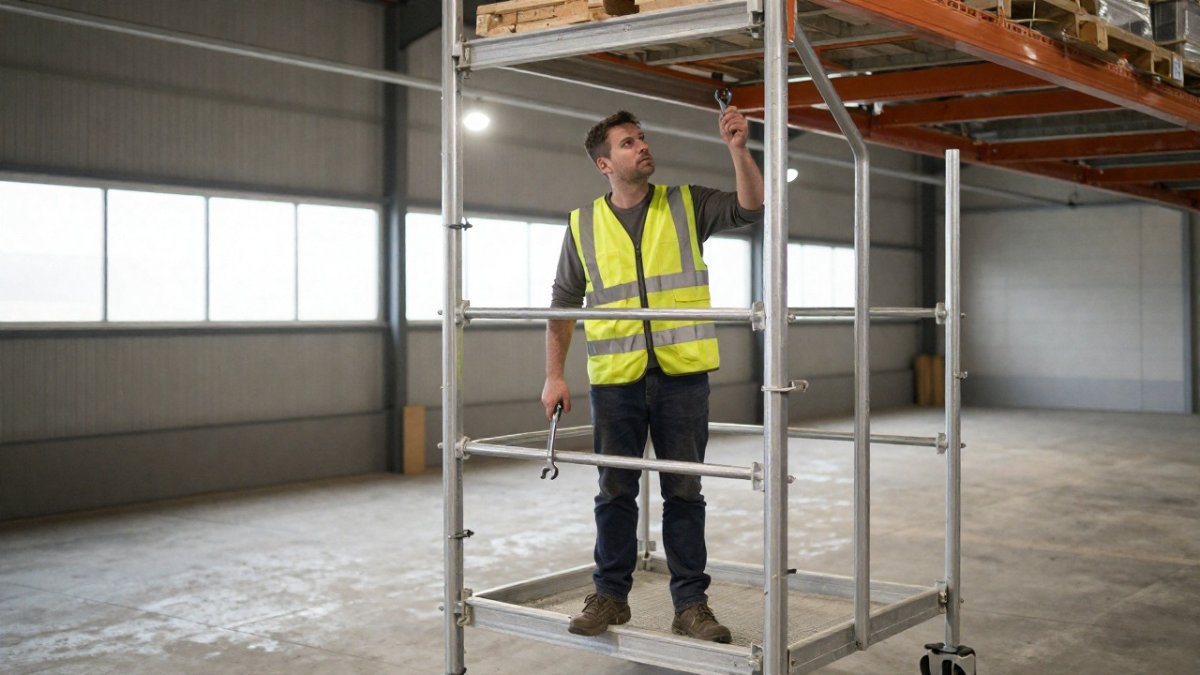
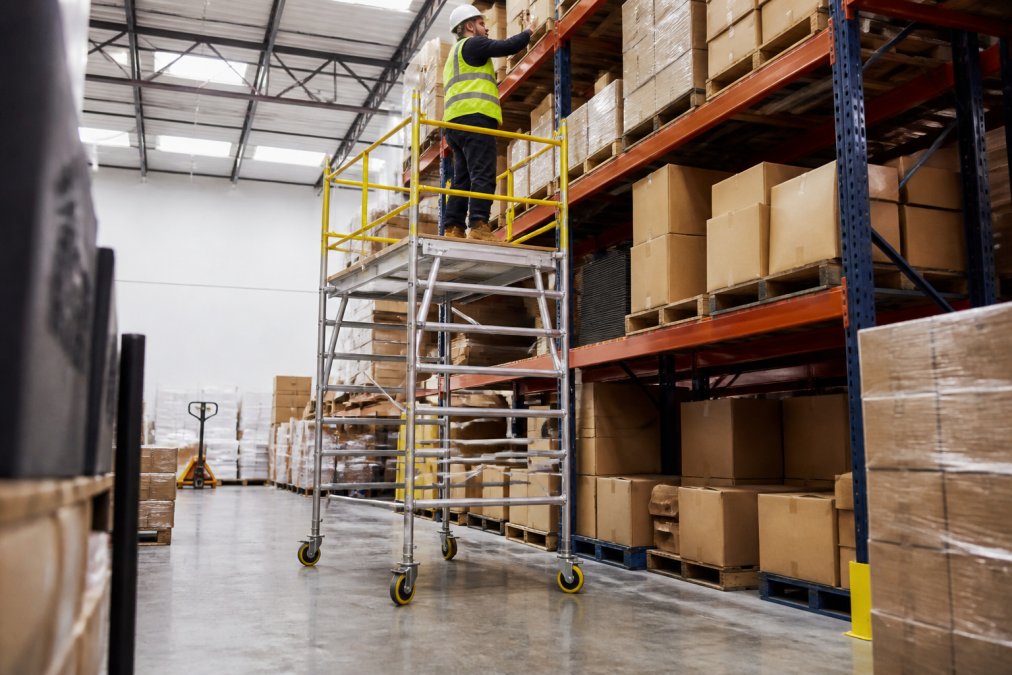
Mobile aluminium towers are the workhorse for retail logistics. They assemble without tools, roll into position on castors and reach working heights well beyond stepladders.
Aluminium keeps the frame light enough for one person to move, while the platform deck gives a full standing area rather than a single rung. Look for towers built to BS EN1004, the standard that governs mobile access towers and their stability testing (bsigroup.com).
For retail sites, the practical advantages are:
- Castors lock in place, so the tower stays put while loaded
- Modular frames adjust to aisle width and racking height
- Non-conductive GRP options suit electrical and utility work nearby
A common mistake is buying a tower rated for the wrong duty. Check the load class before you buy.
Podium Steps and Low-Level Access
Podium steps handle the tasks that don't justify a full tower: shelf replenishment, signage changes, light cleaning and low-level maintenance. They are self-contained, with a guardrail and platform built into one unit.
The trade-off is reach. Podium steps suit work up to around 2 metres of platform height, which covers most shop-floor and back-of-house tasks. Above that, you need a tower.
What most guides miss is that podium steps still count as work at height. They fall under the same regulations as a tower, and they still need inspection.
Work at Height Regulations 2005 Compliance
The Work at Height Regulations 2005 place a duty on employers to avoid work at height where possible, prevent falls where it isn't, and minimise the consequences of any fall (hse.gov.uk). In retail logistics, that means selecting the right platform, not just any platform.
The regulations set out a clear hierarchy. Avoid working at height if a task can be done safely from the ground. Where that isn't possible, use collective protection such as guardrails before relying on personal fall protection.
For retail operations, compliance usually comes down to three things:
- Choosing equipment suited to the task and the person using it
- Ensuring the platform is stable, on firm ground and correctly assembled
- Training staff so they can spot an unsafe setup before they climb
Official guidance on the regulations is published by the Health and Safety Executive. Reading the source document is worth an hour of any facilities manager's time.
PUWER Inspection Requirements for Access Equipment
PUWER, the Provision and Use of Work Equipment Regulations 1998, requires that work equipment is suitable, maintained in safe condition and inspected at suitable intervals. Access towers and podium steps fall squarely within its scope.
There are two inspection layers to keep straight. A pre-use check is a visual once-over before every shift: castors, locking pins, guardrails, deck condition. A formal inspection is a documented, more thorough check carried out at intervals set by your risk assessment.
What most guides miss is that PUWER doesn't specify a fixed inspection frequency. The interval depends on the equipment, the environment and how hard it's used. A tower in daily warehouse use needs more frequent formal checks than one used monthly in a quiet stockroom.
| Inspection Type | Who Carries It Out | Typical Frequency | What It Covers |
|---|---|---|---|
| Pre-use check | Operative | Before every use | Castors, pins, guardrails, deck |
| Formal inspection | Competent person | Set by risk assessment | Full structural and function check |
| Post-incident check | Competent person | After any event | Damage, deformation, stability |
Keep written records. If an inspector or insurer asks, the paper trail is what proves compliance.
Risk Assessment for Working at Height in Retail
Risk assessment for working at height in retail starts with the task, not the equipment. Identify the height involved, the duration, the frequency and the environment, then select the platform that controls the risk.
Retail environments throw up specific hazards that a generic assessment misses:
- Forklift and pedestrian traffic in the same aisle as the tower
- Slippery floors near chiller units or entrances
- Overhead services and sprinkler pipework limiting headroom
- Public access in shop-floor areas during trading hours
A workable assessment names the hazard, states who is at risk, sets out the control and records who owns it. Review it when the task, the equipment or the site changes.
Choosing Safe and Stable Working Platforms for Your Site
Choosing safe and stable working platforms for your site comes down to matching three variables: maximum working height, floor conditions and how often the platform moves. Get those right and the equipment choice follows.
Work through it in this order:
- Measure the highest point anyone needs to reach, then add a safety margin
- Check the floor: level, load-bearing, clear of obstructions
- Estimate how many times the platform will be repositioned per shift
- Confirm the platform is rated to BS EN1004 or the relevant standard
- Verify spare parts and inspection support are available before you buy
A small decorating outfit doing occasional loft work doesn't need the same tower as a distribution centre running daily replenishment. Buy for the job you actually do.
This is where Leader Pro Scaffold Towers fits for many retail and trade buyers. The manufacturer-direct model keeps costs down, towers are built to BS EN1004, and next-day delivery means a site isn't waiting a week for access equipment. The comprehensive spare parts range matters too: a damaged locking pin shouldn't sideline a tower for a fortnight.
Pricing depends on the tower size, configuration and delivery, so check the current figures on the Leader Pro Scaffold Towers site rather than working from a rough estimate.
Frequently Asked Questions
What are the Work at Height Regulations 2005 requirements for retail logistics?
The Work at Height Regulations 2005 require employers to avoid work at height where possible, prevent falls where it cannot be avoided, and minimise the distance and consequences of a fall. In retail logistics, this means providing suitable working platforms, ensuring they are stable and inspected, and that staff are trained. You must also assess risks, plan the work, and ensure equipment is maintained. Compliance is enforced by the Health and Safety Executive (HSE).
How do you ensure stability when using mobile access platforms in warehouses?
Stability starts with a firm, level surface. Use outriggers or stabilisers on aluminium towers, and never move a tower while someone is on it. Check that locking mechanisms are engaged and wheels are braked. For retail logistics, avoid uneven floors or ramps; if unavoidable, use a platform designed for such conditions. Regular PUWER inspections and following the manufacturer's assembly instructions are essential for safe and stable working platforms.
How often should working platforms be inspected under PUWER?
PUWER requires that work equipment is inspected at suitable intervals. For access equipment like scaffold towers, a formal inspection before first use and then at intervals determined by a risk assessment is common practice, as the frequency depends on the environment and use. Additionally, a pre-use check should be done by the operator each time. Records must be kept.
What safety features are essential for retail logistics access equipment?
Essential features include guardrails, toe boards, and a non-slip platform surface. For mobile towers, locking castors and stabilisers are critical. In retail logistics, where aisles may be tight, consider platforms with adjustable legs for uneven floors. Also look for BS EN1004 certification, which confirms the equipment meets safety standards. Training and a robust risk assessment for working at height in retail are equally important.
How to choose between fixed and mobile working platforms for retail?
Choose mobile platforms when you need to move frequently between locations, such as in a warehouse with multiple aisles. Fixed platforms suit repetitive tasks in one spot, like a mezzanine packing station. For retail logistics, mobile aluminium towers offer flexibility and are easy to relocate. Consider the height required, floor conditions, and frequency of movement. Always ensure the platform is suitable for the task and compliant with Work at Height Regulations 2005.
What training do staff need to use working platforms safely?
Staff should receive training on the specific equipment they use, including assembly, moving, and safe working practices. PASMA training is recognised for mobile access towers. For retail logistics, training should cover risk assessment, pre-use checks, and emergency procedures. Refresher training is recommended, especially if equipment changes. Keeping training records helps demonstrate compliance with PUWER and Work at Height Regulations 2005.
Retail logistics rarely allows for downtime, and access equipment that fails inspection or arrives late stalls the whole operation. Leader Pro Scaffold Towers supplies BS EN1004 aluminium towers, podium steps and spare parts with next-day delivery and expert advice on compliance. Get started with Leader Pro Scaffold Towers and keep every working platform on your site safe, stable and ready to use.