 How-to
Do You Need a Scaffold Tower Stabiliser Installation Service?
Last Updated: 16 November 2026
Quick Summary
You only need a stabiliser installation service when the setup stops being routine: towers at or near maximum rated height, sloping, soft or obstructed ground, or sites near overhead lines or electrical equipment. For standard setups, stabilisers are a bolt-on job you can fit yourself in minutes with a spanner, following the manufacturer's instructions.
- Fit stabilisers to the base frame before the tower goes up, never after it is fully built.
- Towers above roughly 5 m working height commonly need stabilisers or outriggers, but the manual governs.
- Check the stabiliser's adjustment range covers your ground, including any slope or camber.
- Inspect before every use and reinspect after the tower is moved, altered or exposed to high winds.
- A professional installer confirms the component choice, fits it and signs off the setup.
Table of Contents
- When a Scaffold Tower Stabiliser Installation Service Makes Sense
- Stabilisers or Outriggers: What Your Tower Actually Needs
- Choosing Stabilisers for Your Specific Tower
- Step-by-Step Stabiliser Installation Guide
- Scaffold Tower Inspection Checklist After Fitting
- Scaffold Tower Assembly Instructions and Safe Working Height
- When to Call a Professional Installer
- Book Your Stabiliser Installation or Order the Kit
- Frequently Asked Questions
When a Scaffold Tower Stabiliser Installation Service Makes Sense
A scaffold tower stabiliser installation service is a paid fitting service where a trained operative attaches stabilisers to a mobile access tower and checks the setup.
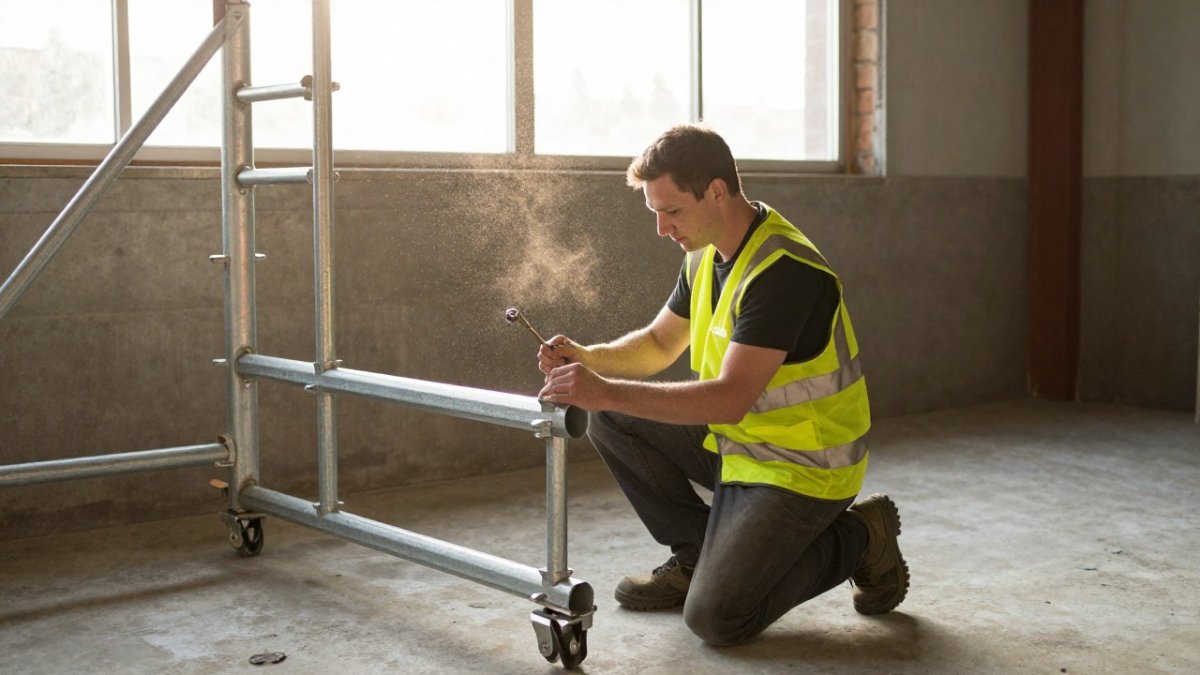
Most stabilisers are a bolt-on job that takes minutes with a spanner and the manufacturer's instructions.
But "rarely" is not "never". A stabiliser installation service earns its fee in three situations:
- High towers. The taller the tower, the less room for error in the base setup.
- Awkward ground. Sloping, soft or obstructed surfaces change how stabilisers sit and load.
- Tight programmes. A crew that cannot spare an operative for setup benefits from someone else doing it properly.
The rest of this guide covers what stabilisers do, how to choose them, how to fit them step by step, and when to stop and call someone in.
Stabilisers or Outriggers: What Your Tower Actually Needs
Stabilisers and outriggers both widen the tower's effective base, but they are not the same component and they are not interchangeable.
HSE guidance on tower scaffolds is clear that tower provision and use must be properly managed, with inspection built in.
Which one you need depends on the tower. Check your tower's own manual first: the manufacturer's instructions govern what your model needs.
For electrical work, a non-conductive option matters. Our GRP telescopic stabilisers suit BoSS Zone 1 and UTS towers and are non-conductive, non-sparking and corrosion resistant. If you are weighing up whether outriggers are the right call instead, read our guide on whether you need outriggers.
Choosing Stabilisers for Your Specific Tower
Compatibility comes before anything else. A stabiliser that does not match your tower's frame is not a stabiliser, it is a hazard. Most hire pages stop at "check compatibility"; this section gives you a way to actually do it.
Start With the Manufacturer's Configuration, Not the Height Alone
The tower manual states the stabiliser requirement for each configuration, and that requirement is usually expressed as a combination of working height, platform width and whether the tower is single or double width.
A common pattern is that towers above roughly 5 m working height need stabilisers or outriggers, but that is a rule of thumb from hire guidance, not a substitute for the manual.
Match the Stabiliser to the Base Frame
Run through these before you buy or fit:
- Confirm the tower's make and model, not just its height
- Check the manual's stated stabiliser requirement for that height and width
- Match the stabiliser's clamp or fixing to your base frame size and tube diameter
- Confirm the stabiliser's adjustment range covers your ground conditions
Our standard LEADER PRO 2.2m scaffold tower stabilisers are heavy-duty aluminium, made here, and compatible with LEADER PRO, BoSS and UTS systems. That compatibility list is the first thing to check, because a stabiliser that fits one frame will not necessarily fit another.
Work Out the Adjustment Range You Need
What most buyers miss is the adjustment range. A stabiliser that reaches the ground on flat concrete may not reach on a camber or a gravel base, and that is where people improvise with blocks. Don't. Measure the distance from the base frame fixing point to the ground at the outermost point the stabiliser will sit, including any slope or camber, and compare it with the stabiliser's stated range.
Check the Footprint and Access Implications
Stabilisers extend outward, so they change the tower's footprint and can obstruct walkways, doorways or vehicle routes.
For electrical work, a non-conductive option matters. Our GRP telescopic stabilisers suit BoSS Zone 1 and UTS towers and are non-conductive, non-sparking and corrosion resistant.
Watch out: buying stabilisers by height alone is the most common compatibility error, because the same height on a different width or frame system can need a different component.
Step-by-Step Stabiliser Installation Guide
Fitting stabilisers is straightforward when the tower is set up correctly first. Work in this order and the job takes minutes per leg.
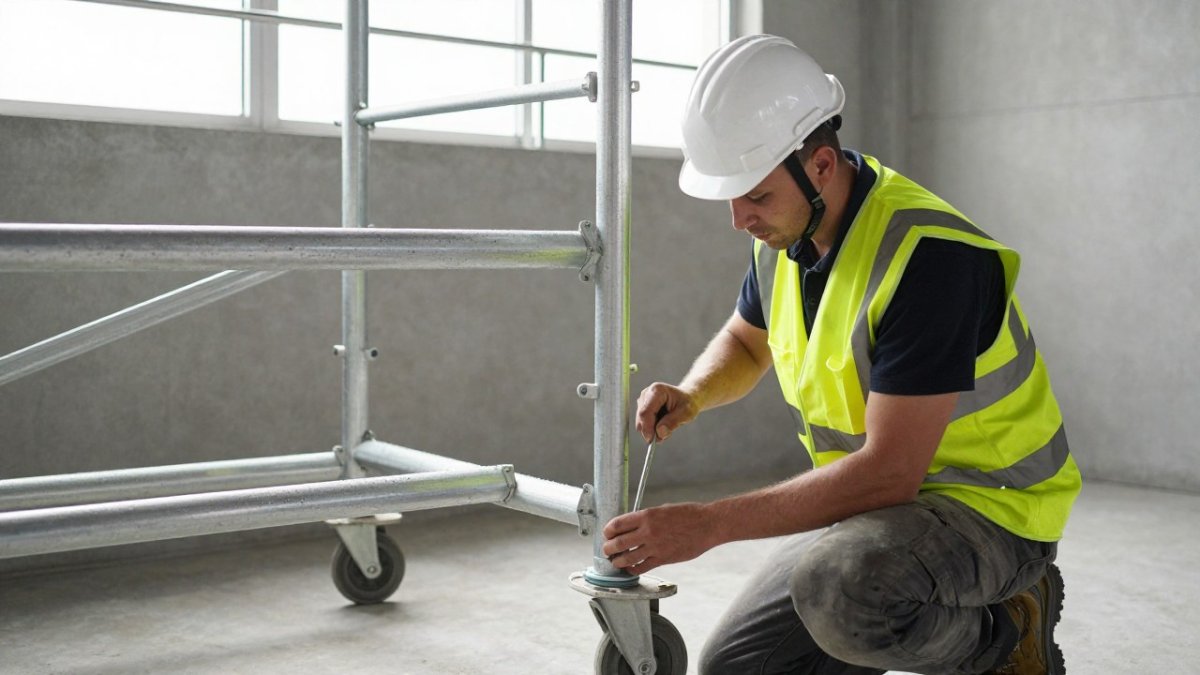
- Lock every castor and confirm the tower is on firm, level ground.
- Fit the stabilisers to the base frame before the tower goes up, following the manufacturer's instructions for clamp position.
- Extend each stabiliser leg outward and down until the footpad sits flat on the ground.
- Tighten all clamps and fixings with the correct spanner, checking each one by hand afterwards.
- Check the tower is level in both directions, adjusting the stabiliser legs as needed.
- Re-check every fixing once the tower is fully built and before anyone climbs.
Watch out: fitting stabilisers after the tower is fully built, rather than before, is the mistake we see most. It means working at the base of a tall, unbraced tower, which is exactly the situation stabilisers exist to prevent.
Common Installation Errors and Troubleshooting
Most failures come down to a handful of avoidable mistakes:
- Clamps left hand-tight. Stabilisers work by resisting movement; a loose clamp defeats the purpose. Tighten, then check.
- Footpads on soft ground. A footpad that sinks is not bearing load. Use a firm base or spread the load.
- Stabilisers fitted but not extended. A stabiliser folded against the frame adds nothing. Extend it fully.
- Mismatched components. A stabiliser from a different system may clamp but not load correctly.
If a stabiliser will not sit flat, do not shim it with offcuts. Stop and check the ground and the adjustment range. Our guide to common assembly mistakes covers the wider set of errors, including wrong stabilisers, that catch people out on site.
Fitting stabilisers is a short job when you follow the right order.
| Step | What to do |
|---|---|
| 1 | Lock every castor and confirm firm, level ground |
| 2 | Fit stabilisers to the base frame before the tower goes up |
| 3 | Extend each leg outward and down until the footpad sits flat |
| 4 | Tighten all clamps and fixings, then check by hand |
| 5 | Check the tower is level in both directions |
| 6 | Re-check every fixing once the tower is fully built |
Scaffold Tower Inspection Checklist After Fitting
Once the stabilisers are on, inspect before every use. This is not optional: HSE's scaffold inspection guidance sets out that tower scaffolds need rigorous inspection arrangements as part of proper management. The checklist below explains what each item is actually checking, so you can tell a pass from a fail rather than ticking boxes.
What Each Check Is Looking For
- All four stabilisers fitted and fully extended, a stabiliser folded against the frame adds nothing; each leg should be extended until the footpad bears on the ground.
- Every clamp and fixing tight, checked by hand, stabilisers work by resisting movement, so a hand-tight clamp that yields under load defeats the purpose. Tighten with the correct spanner, then check by hand.
- Footpads flat and bearing on firm ground, a footpad that sinks or sits on a camber is not bearing load. Check for soft spots, gravel and drainage covers.
- Tower level in both directions, use a spirit level on the base frame, not the platform, and adjust the stabiliser legs rather than shimming the castors.
Recording and Reinspection Triggers
Record the inspection with the date, the tower's location, the name of the person who inspected it and any defects found. Reinspect after any of the following, because each changes the setup the stabilisers were fitted to:
- The tower is moved, even a short distance
- The tower is altered, dismantled or re-erected
- Ground conditions change, for example after rain or when plant moves nearby
- The tower is exposed to high winds or has been struck
If anything fails, take the tower out of use until it is fixed. Do not use the tower while a defect is outstanding, and do not rely on a previous inspection if conditions have changed.
Watch out: treating the checklist as a one-off at first erection is the most common inspection failure, because the ground and the tower's condition change during the job.
Scaffold Tower Assembly Instructions and Safe Working Height
Assembly and stability are one topic, not two. The stabilisers are only as good as the build above them.
Follow the manufacturer's assembly sequence exactly: base frame, castors locked, braces, platform levels, guardrails. Fit stabilisers at the base stage, not at the end. Never climb a tower that is incomplete or missing braces.
Scaffold Tower Safe Working Height Explained
Safe working height is the height at which the platform sits, plus the reach you need, and it is limited by the tower's design and its stability setup.
That is why the height question and the stabiliser question are the same question. For the full picture on limits, wind conditions and setup, read our guide on how high a scaffold tower can safely go.
When to Call a Professional Installer
Call a professional when the setup stops being routine. Specifically:
- The tower is at or near its maximum rated height
- Ground is sloping, soft, or obstructed
- The tower sits near overhead lines or on a live site with traffic
- You are working near or on electrical equipment and need non-conductive components
A professional installer confirms the component choice, fits it, and signs off the setup. That sign-off has value on a commercial site where inspection records are audited.
For everything else, fitting stabilisers yourself is a sensible, safe job. We would rather tell you that than sell you a service you don't need.
Book Your Stabiliser Installation or Order the Kit
The right call depends on your tower, your ground and your site rules.
Either way, start with the right component. Leader Pro Scaffold Towers supplies BS EN1004 aluminium towers, manufacturer-direct pricing, next-day UK delivery and a comprehensive range of spare parts.
Get started with Leader Pro Scaffold Towers and fit your stabilisers with confidence.
Choosing the right stabiliser is the difference between a tower that stands firm and one that doesn't.
Frequently Asked Questions
How do you install stabilisers on a scaffold tower?
Fit stabilisers before the tower goes up, working on firm level ground with the castors locked. Attach each stabiliser to the base frame at the manufacturer's fixing points, angle the leg out to the specified spread, and tighten the clamps fully. Check the tower is level, then confirm no leg lifts when you apply gentle downward pressure. Follow the manufacturer's instructions throughout, and never fit stabilisers to a partly built tower where the base has already been loaded.
When should stabilisers be fitted to a scaffold tower?
Stabilisers or outriggers are typically required once a tower's working height passes around 5 m, though the exact trigger comes from the manufacturer's instructions and your risk assessment. Many suppliers also specify them for single-width towers at lower heights, or where the tower is exposed to wind on an open site. If in doubt, follow the manufacturer's instructions and your risk assessment.
Are scaffold tower stabilisers and outriggers the same thing?
They do a similar job but are not identical. Stabilisers are legs that extend from the tower base to widen its footprint, usually with a fixed or adjustable spread. Outriggers are larger frames or beams that extend further out and are common on taller towers. Both widen the base and reduce tipping risk, and both must be fitted according to the tower manufacturer's instructions, since mixing parts from different systems can leave the tower unsupported.
What checks should be carried out after fitting scaffold tower stabilisers?
Work through a scaffold tower inspection checklist: confirm every clamp and fixing is tight, the stabiliser feet sit flat on firm ground, the tower is level in both directions, and all four legs stay grounded when you press down on each corner. Check guardrails, toe boards and the platform are secure, and that the stabilisers do not obstruct access. Record the inspection before first use, then repeat it at the start of each shift and after any move or alteration.