 blog
Are Lightweight Scaffold Towers Worth It Indoors?
Last Updated: November 22, 2026
Quick Summary
Lightweight scaffold towers give indoor maintenance teams a stable working platform that can be assembled quickly, moved through standard doorways, and used across finished floors with appropriate load-spreading. They combine portability with stability for ceiling repairs, lighting swaps and high-level decorating, and a two-person team can erect one in a fraction of the time a fixed scaffold takes.
- Aluminium delivers the strength of steel at a fraction of the weight, so sections are manageable for one person.
- Measure the narrowest access point, including fire doors and lift openings, before choosing a tower.
- Working height is platform height plus around 2 metres of reach, with guardrail height added for ceiling clearance.
- Move a tower only with the platform clear and castors unlocked, pushing from the base.
- Spread weight with load-spreading boards under castors on finished, raised or suspended floors.
Table of Contents
- What are the benefits of lightweight scaffold towers for indoor maintenance?
- Why aluminium towers suit indoor work
- Indoor constraints: doorways, corridors and floor loading
- Scaffold tower vs ladder for indoor maintenance
- How to work out scaffold tower working height
- Scaffold tower safety indoors
- Your scaffold tower inspection checklist
- Choosing the right tower for your next indoor job
- Frequently Asked Questions
What are the benefits of lightweight scaffold towers for indoor maintenance?
Lightweight scaffold towers give indoor maintenance teams a stable working platform that can be assembled quickly, moved through standard doorways, and used across finished floors with appropriate load-spreading.
Aluminium towers are widely used by contractors and facilities teams who work inside occupied buildings.
The gains come down to four things:
- Speed. A two-person team can erect a tower in a fraction of the time a fixed scaffold takes, with no waiting on a scaffolding contractor.
- Safety. A guarded platform with toe boards removes the balance-and-reach problem that makes ladders risky.
- Manoeuvrability. Castors let one person reposition the tower between ceiling grids or light fittings.
- Cost. Buying a tower outright can be weighed against repeat hire for a season of maintenance work, depending on how often it is used.
Below, we break down where lightweight towers earn their place indoors, where they fall short, and how to choose the right one.
Why aluminium towers suit indoor work
Aluminium is the default material for indoor towers because it delivers the strength of steel at a fraction of the weight. That matters when you are carrying sections up stairwells, through fire doors and across carpeted floors.
Strength, stability and load capacity
A well-built aluminium tower is not a compromise on strength. A compliant tower carries a rated platform load and holds it steady when you lean out to work.
Stability indoors depends on setup as much as materials. Wind is rarely a factor inside a building, but uneven floors, trailing cables and soft flooring are. Stabilisers or outriggers, correctly fitted castors and a level base do more for stability than any single component.
Transport, handling and quick assembly
This is where lightweight construction pays off most. Individual tower sections are manageable for one person, so a two-person team can move a full kit in a van or estate car and carry it through a building without a trolley.
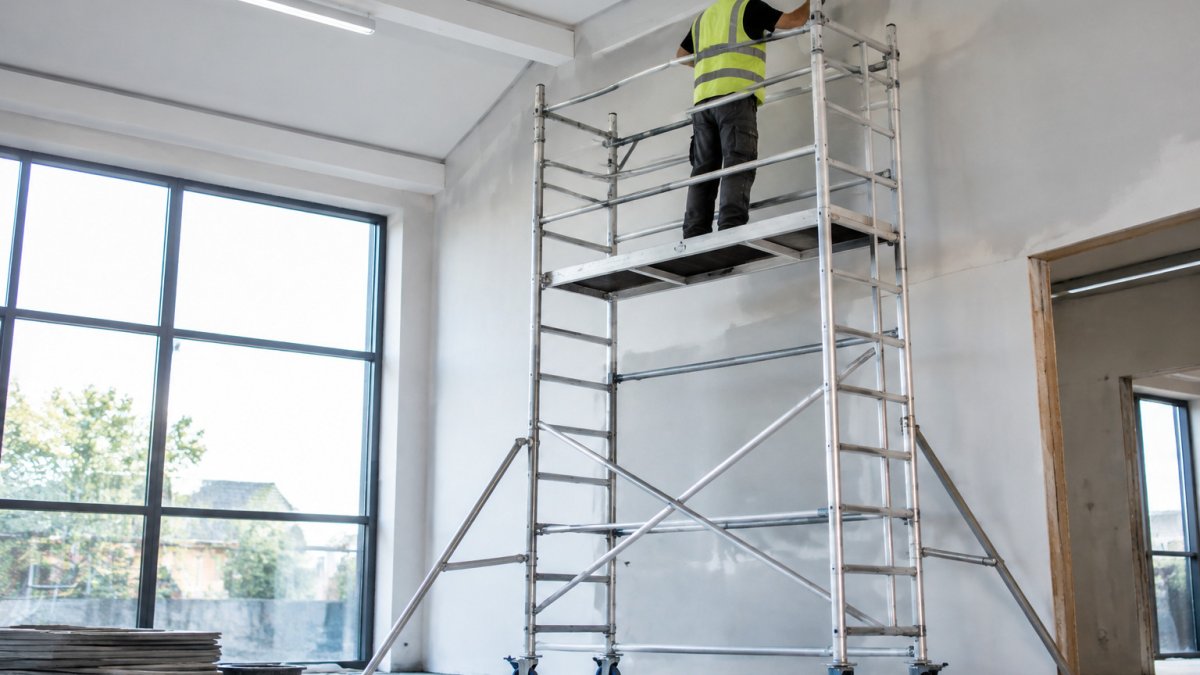
Assembly follows a fixed sequence: base frames, castors, braces, platforms, guardrails. Follow the manufacturer's instructions and the tower goes up quickly and comes down just as fast.
Indoor constraints: doorways, corridors and floor loading
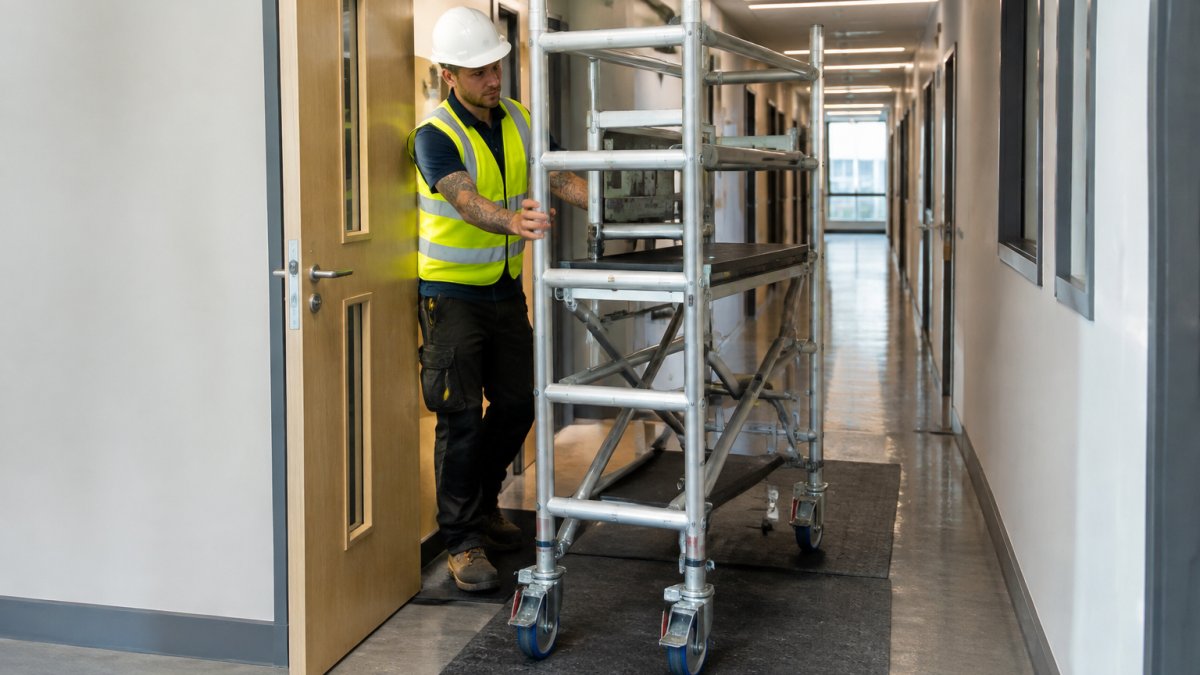
The building itself often decides which tower you can use. Standard internal doorways and tight corridors can rule out wide-span towers, and low ceilings can limit how many sections you can stack.
- Doorway and corridor width. Measure the narrowest point on your access route, including fire doors, turnstiles and lift openings, and check that the tower's collapsed width will pass through it. A tower that will not fit through the door is no use, however good the platform.
- Ceiling height. You need clearance above the guardrail, not just at platform level. Add the guardrail height to your platform height and compare it with the lowest obstruction, light fittings, ductwork, sprinkler pipework or suspended ceiling grids. A tower set too high for the room is a hazard, not a help.
- Floor loading. Finished floors, raised access floors and mezzanines have limits. Spread the tower's weight with load-spreading boards under the castors, and check with the building manager on suspended floors. The point load under each castor is what matters, spreading boards reduce that pressure and protect both the floor and the tower's stability.
- Floor protection. Castors mark vinyl and scratch timber. Protective mats under the wheels are cheap insurance, and they also damp vibration that travels through suspended floors.
- Noise and disruption. Aluminium sections clatter when they are assembled and dismantled. In offices, schools, shops and homes, plan erection for quiet periods, carry sections rather than dragging them, and keep the work area screened so the public cannot walk underneath.
Watch out: moving a tower with someone or something on the platform is the most common indoor mistake. Always clear the platform and push from the base.
Scaffold tower vs ladder for indoor maintenance
For anything beyond a quick reach, a tower wins on safety. A ladder gives you two points of contact and a narrow stance. A tower gives you a full platform, guardrails and somewhere to put your tools.
Here is the practical comparison for indoor jobs:
| Factor | Ladder | Podium step | Mobile scaffold tower |
|---|---|---|---|
| Typical working height | Low to medium | Low | Low to high |
| Stability under reach | Limited | Moderate | High |
| Tools and materials on platform | No | Small tray | Full platform |
| Setup time | Seconds | Seconds | Minutes |
| Repositioning | Carry and reset | Carry and reset | Roll on castors |
| Best for | Quick single reaches | Short tasks at low height | Sustained work at height |
A ladder still has a place for a two-minute job. For a detailed breakdown, see our mobile scaffold tower vs ladder safety comparison.
How to work out scaffold tower working height
Working height is platform height plus your reach, usually taken as 2 metres for a person standing and working overhead. So a tower with a 2-metre platform gives roughly a 4-metre working height.
Get this wrong and you either buy a tower that is too short or one that will not fit under the ceiling. Work backwards from the job:
- Measure the height of the task, such as the ceiling or light fitting.
- Subtract your comfortable overhead reach, around 2 metres.
- That figure is your required platform height.
- Add guardrail height, typically 1 metre, to check ceiling clearance.
- Confirm the tower's maximum platform height meets BS EN1004 limits for its size.
Our guide to how high a scaffold tower can safely go covers the height limits, stabiliser requirements and setup rules in detail.
Scaffold tower safety indoors
Indoor work brings its own hazards: low ceilings, cables underfoot, other trades in the same space and members of the public nearby. Safe working practices cover all of them.
Before every use, check the tower is complete, all braces are fitted, castors are locked and guardrails and toe boards are in place. Never mix components from different towers, and never climb on the outside of the frame.
Moving and repositioning on indoor floors
Move a tower only with the platform clear and the castors unlocked. Push from the base, never pull from the top. Watch for floor transitions, thresholds and cable ramps that can catch a castor and tip the tower.
On smooth floors, two people should guide the tower, one at each end, and lock the castors the moment it reaches position. On carpet or uneven surfaces, check the tower is level before anyone climbs.
Your scaffold tower inspection checklist
Run this checklist before every use. It takes two minutes and catches the faults that cause most incidents.
- All braces and horizontal members fitted and locked
- Castors locked and free of debris
- Stabilisers or outriggers fitted where required
- Guardrails and toe boards in place on all sides
- Platform boards fully seated, no gaps or damage
Any damaged component should be replaced before use. Our list of common scaffold tower assembly mistakes covers the faults that inspectors find most often.
Choosing the right tower for your next indoor job
Match the tower to the job, not the other way round.
Map common indoor jobs to suitable equipment:
| Task | Typical duration | Reach needed | Best starting point |
|---|---|---|---|
| Swapping a light fitting or ceiling tile | Minutes | Low | Podium step or small tower |
| Painting a ceiling or high wall | Hours | Medium to high | Mobile tower with full platform |
| HVAC filter changes or vent cleaning | Hours, repeated | Medium to high | Mobile tower with castors |
| Inspection of roof lights or services | Short but frequent | Medium | Compact tower or podium step |
| Cable tray or conduit work | Hours | Medium to high | Mobile tower with tool tray |
For anything beyond a quick reach, a tower wins on safety and productivity. A ladder gives you two points of contact and a narrow stance.
Compare the options on the factors that matter indoors:
- Task duration. Under a few minutes, a ladder or podium step is often enough. Beyond that, the repeated climbing and limited stance of a ladder cost time and increase fatigue; a tower lets you work with both hands and keep tools on the platform.
- Reach. Podium steps typically top out at low working heights, while a mobile tower can be built to the ceiling height you actually have, within BS EN1004 limits.
- Stability under reach. A tower with outriggers or stabilisers holds steady when you lean out; a ladder relies on your balance.
- Repositioning frequency. If you are moving between ceiling grids or light fittings every few minutes, castors save more time than any other feature. If the tower has to go through doorways between rooms, check the collapsed width first.
- Available space. Narrow corridors and furnished rooms favour compact towers; wide open halls can take a larger deck.
Ask three questions before you buy:
- What is the highest task? That sets your platform height requirement.
- What is the narrowest access point? That sets your maximum tower width.
- How often will you use it? Frequent use favours buying; occasional use may favour hire. Weigh the purchase price against repeat hire costs over a season, and factor in setup time and labour. Pricing depends on quantity, dates and delivery, so check the website for current prices or a quote.
For trade and facilities teams, our LEADER PRO 250 industrial scaffold tower range is built for exactly this work: lightweight aluminium construction, with next-day delivery and a comprehensive range of spare parts available. If you are still weighing up whether a tower is worth the outlay for smaller jobs, our article on aluminium towers for small projects walks through the numbers.
Indoor maintenance rarely gives you the luxury of space, time or a second pair of hands. A lightweight tower solves all three, provided you buy one that fits your access route, your ceiling heights and your floors.
Frequently Asked Questions
Are aluminium scaffold towers suitable for indoor use?
Yes. Aluminium is the usual choice for indoor work because the frames and platforms are light enough for one or two people to handle, and the tower can be built in sections that fit through standard doorways. Check that any tower you buy carries the certification you need, keep it on a flat, sound floor, and use the castors with the brakes on before anyone climbs. Avoid using aluminium near live electrical work; for that you need a non-conductive GRP tower instead.
Can scaffold towers be used on uneven indoor floors?
Only with care. A tower needs a firm, level base, so use the adjustable legs to compensate for slight slopes and check with a spirit level before climbing. Loose boards, gravel, soft subfloors and damaged tiles are not suitable without spreading the load first. If the floor cannot be made level, move the tower or use a different access method rather than packing the feet with loose material.
Do scaffold towers need to be inspected before use?
Yes. A pre-use check takes a couple of minutes and should cover the frame, braces, platform boards, guardrails, toe boards and castors. Look for bent tubes, cracked welds, missing pins and damaged wheels, and confirm the brakes hold. Any tower that has been dropped, struck or left on site should be checked again before it is used.
How do you move a mobile scaffold tower safely indoors?
Clear the route first, including door thresholds, cables and floor mats. Everyone comes down, tools and materials are removed, and the tower is pushed at the base by at least two people, never pulled from above. Watch the ceiling, light fittings and door frames as you go, and lock the castors again before anyone climbs back up. Never move a tower with someone on the platform.